George MacDonald (1824-1905) was a Scottish preacher and teacher as well as an author of 30 novels, numerous fairy tales, poetry, essays, and sermons. He was one of the most original of nineteenth century thinkers.
MacDonald's writing and lecturing brought him great recognition and introduced him into the company of many of the leading Victorians of the time. His friends included many of the English pre-Raphaelites, social reformers such as Octavia Hill, radical churchmen such as F.D. Maurice, and, across the Atlantic, Emerson, Whittier, Oliver Wendell Holmes, and Mark Twain.
MacDonald's writing has outstanding imaginative power, largely influenced by the German and English Romantics. Through his visionary theology, MacDonald has made his greatest contributions in the realms of fantasy and children's literature. His fairy tales for children and his two fantasies for adults are his best literary achievements. At the Back of the North Wind, The Princess and The Goblin and The Princess and Curdie have found a permanent place on children's bookshelves. A number of writers of children's literature refer to him as the greatest writer of fantasy for children.
George MacDonald's Phantastes is recognized as a classic of adult fantasy writing. It was Phantastes which C.S. Lewis read as a teenager that initiated his extraordinary imagination. Other well known authors besides Lewis who have been influenced by MacDonald include G.K. Chesterton, W.H. Auden, and Madeleine L'Engle.
MacDonald's novels were popular in his day, but then fell out of favor, partly because of his didacticism, and were out of print for many years. His novels have some of the finest Christian teaching. Two of his major themes are the loving (tough love) nature of our Father God and the importance of obedience in our Christian growth.
The impact of many of his novels is being rediscovered, particularly in Scotland and the United States. His influence on both John Ruskin and Lewis Carroll was profound and his influence upon 20th century literature has been far-reaching, mainly through other writers. The works of C. S. Lewis, G.K. Chesterton and W.H. Auden bear a witness to the power of MacDonald's imagination, a power which remains undiminished for the reader of today.
From http://www.taylor.edu/academics/supportservices/cslewis/inklings/macdonald.shtml
Thursday, February 28, 2008

Wednesday, February 27, 2008
Comic Books

While comic books might not be considered children' s literature practically everyone has read them during their childhood. I can remember my dad taking me to our local comic book store almost every Saturday. I grew up reading the Uncanny X-Men, Spiderman, Batman, and the occasional Wonder Woman. My favorite is has always been Batman. I love that he is a regular (well as regular as any millionaire can be) guy, he doesn't have any special powers or come from another planet; he is simply a smart person who uses detective reasoning and has, quite frankly, some kick arse skills. I think what draws me to comic books is that they are written really, really well not to mention that the artwork is simply breathtaking.
I've also been a fan of The Uncanny X-Men since I was probably about eight (my fasination with Batman appears to have been genetic). I love that in the comic book world you can be anything you want which is, I believe the main reason that comics are soooo fasination.
Monday, February 25, 2008
Jabberwocky
Since we are almost done with Alice's Adventures in Wonderland, I thought I would post my favorite Lewis Carroll poem (which appears in Through the Looking-Glass and What Alice Found There). I absolutely love this poem! I remember the first time I heard it; it was in my sophomore English class. My teacher mentioned it in passing and said that it was something that we should read if we got the chance. I loved it immediately, I even ended up analyzing it my junior year for an assignment. Every time I hear Lewis Carroll, I immediately think of the Jabberwocky.
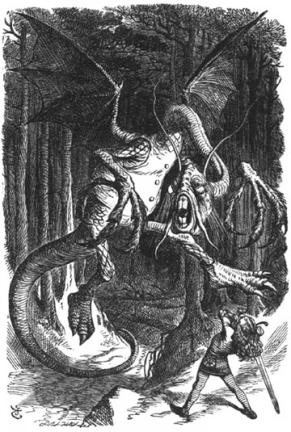
Did gyre and gimble in the wabe;
All mimsy were the borogoves,
And the mome raths outgrabe.
`Twas brillig, and the slithy toves
Did gyre and gimble in the wabe:
All mimsy were the borogoves,
And the mome raths outgrabe.
"Beware the Jabberwock, my son!
The jaws that bite, the claws that catch!
Beware the Jubjub bird, and shun
The frumious Bandersnatch!"
He took his vorpal sword in hand:
Long time the manxome foe he sought --
So rested he by the Tumtum tree,
And stood awhile in thought.
And, as in uffish thought he stood,
The Jabberwock, with eyes of flame,
Came whiffling through the tulgey wood,
And burbled as it came!
One, two! One, two! And through and through
The vorpal blade went snicker-snack!
He left it dead, and with its head
He went galumphing back.
"And, has thou slain the Jabberwock?
Come to my arms, my beamish boy!
O frabjous day! Callooh! Callay!'
He chortled in his joy.
Did gyre and gimble in the wabe;
All mimsy were the borogoves,
And the mome raths outgrabe.
Thursday, February 21, 2008
Fantasy Study Guide
Animal Fantasies
- Animals talk and exhibit human emotions
- A familiar theme: the magic only works if one remains childlike and innocent, untainted by the evils of adult society.
- Became popular in the 20th century
- Beatrix Potter’s picture book fantasies were among the first true examples of the genre in which animals are the chief focus
- Animal fantasy constitutes a form of literary symbolism, the animal characters symbolizing human counterparts, and these fantasies are often vehicles for exploring human emotions, values, and relationships.
- The Tale of Peter Rabbit, The Wind in the Willows, Charlotte’s Web
Toy Fantasies
- Stories of toys that come to life
- Modern toy fantasies are typically found in picture-book format
- Winnie-the-Pooh, Pinocchio, Corduroy, Alexander and the Wind-up Mouse
Magical Fantasies and Tall Tales
- In many magical fantasies, the magic itself becomes the subject of the story
- In a tall tale the exaggeration is taken to absurdity
- Mary Poppins, The Five Children and It, Pippi Longstocking, Paul Bunyan, Johnie Appleseed
Enchanted Journeys and Alternative Worlds
- Enchanted journeys typically begin in the real world and then, by some device the principle character is allowed to enter the enchanted realm.
- The journey may have some purpose, but that purpose is often overshadowed by the thrill offered by the extraordinary events that happen in the fantasy world.
- Plots are usually loose and episodic - a string of events that center around the main character.
- The Wonderful Wizard of Oz, Peter Pan, Alice’s Adventures in Wonderland
Heroic or Quest Fantasy
- We share the exploits and adventures of the hero
- Usually tightly woven, with all of the action directed toward a single purpose – the triumph of good over evil
- Frequently features a quest for identity
- The central character acts decisively
- Plot consists of a series of adventures
- Themes: the necessity for good to overcome evil, the defense of an entire society, the search for a rightful ruler
- The Lord of the Rings Trilogy, The Lion, The Witch, and the Wardrobe, The Dark is Rising series
Science Fiction and Space Fantasy
- Usually focuses on life in the future
- Can closely resemble heroic fantasy, with magic replaced by technology
- Typically does not contain humor
- When the Tripods Came, A Wrinkle in Time, The Runaway Robot
Tuesday, February 19, 2008
Censorship
One of the biggest issues I see in children's literature is censorship. It seems like every day there is yet another group of people calling for a great children's books to be taken off of the library selves. I understand some people don't want their children to read certain books but since when did that give them the right to decide what everyone else could read? If you don't want your kid to read it fine, but don't expect others to do the same. What irrates me the most about censorship is that 95% of the time the people calling for a books removal haven't even read the book. To me, if you haven't read the book then you don't have a right to be judgemental. Basically what it all boils down to is the fact that "censors don't want children exposed to ideas different from their own. If every individual with an agenda had his/her way, the shelves in the school library would be close to empty. ~ Judy Bloom"
Today, it's not only language and sexuality (the usual reasons given for banning my books) that will land a book on the censors' hit list. It's Satanism, New Age-ism and a hundred other isms, some of which would make you laugh if the implications weren't so serious. Books that make kids laugh often come under suspicion; so do books that encourage kids to think, or question authority; books that don't hit the reader over the head with moral lessons are considered dangerous. ~ Judy Bloom
Today, it's not only language and sexuality (the usual reasons given for banning my books) that will land a book on the censors' hit list. It's Satanism, New Age-ism and a hundred other isms, some of which would make you laugh if the implications weren't so serious. Books that make kids laugh often come under suspicion; so do books that encourage kids to think, or question authority; books that don't hit the reader over the head with moral lessons are considered dangerous. ~ Judy Bloom
Monday, February 18, 2008
Information on Lewis Carroll
Lewis Carroll is the pseudonym of the English writer and mathematician Charles Lutwidge Dodgson, b. Jan. 27, 1832, d. Jan. 14, 1898, known especially for ALICE'S ADVENTURES IN WONDERLAND (1865) and THROUGH THE LOOKING GLASS (1872), children's books that are also distinguished as satire and as examples of verbal wit. Carroll invented his pen name by translating his first two names into the Latin "Carolus Lodovicus" and then anglicizing it into "Lewis Carroll."
The son of a clergyman and the firstborn of 11 children, Carroll began at an early age to entertain himself and his family with magic tricks, marionette shows, and poems written for homemade newspapers. From 1846 to 1850 he attended Rugby School; he graduated from Christ Church College, Oxford, in 1854. Carroll remained there, lecturing on mathematics and writing treatises and guides for students. Although he took deacon's orders in 1861, Carroll was never ordained a priest, partly because he was afflicted with a stammer that made preaching difficult and partly, perhaps, because he had discovered other interests.
Among Carroll's avocations was photography, at which he became proficient. He excelled especially at photographing children. Alice Liddell, one of the three daughters of Henry George Liddell, the dean of Christ Church, was one of his photographic subjects and the model for the fictional Alice.
Carroll's comic and children's works also include The Hunting of the Snark (1876), two collections of humorous verse, and the two parts of Sylvie and Bruno (1889, 1893), unsuccessful attempts to re-create the Alice fantasies.
As a mathematician, Carroll was conservative and derivative. As a logician, he was more interested in logic as a game than as an instrument for testing reason. In his diversions as a photographer and author of comic fantasy, he is most memorable and original--the man who, for example, contributed, in "Jabberwocky," the word chortle, a portmanteau word that combines "snort" and "chuckle," to the English language.
http://http://www.insite.com.br/rodrigo/text/lewis_carroll.html
The son of a clergyman and the firstborn of 11 children, Carroll began at an early age to entertain himself and his family with magic tricks, marionette shows, and poems written for homemade newspapers. From 1846 to 1850 he attended Rugby School; he graduated from Christ Church College, Oxford, in 1854. Carroll remained there, lecturing on mathematics and writing treatises and guides for students. Although he took deacon's orders in 1861, Carroll was never ordained a priest, partly because he was afflicted with a stammer that made preaching difficult and partly, perhaps, because he had discovered other interests.
Among Carroll's avocations was photography, at which he became proficient. He excelled especially at photographing children. Alice Liddell, one of the three daughters of Henry George Liddell, the dean of Christ Church, was one of his photographic subjects and the model for the fictional Alice.
Carroll's comic and children's works also include The Hunting of the Snark (1876), two collections of humorous verse, and the two parts of Sylvie and Bruno (1889, 1893), unsuccessful attempts to re-create the Alice fantasies.
As a mathematician, Carroll was conservative and derivative. As a logician, he was more interested in logic as a game than as an instrument for testing reason. In his diversions as a photographer and author of comic fantasy, he is most memorable and original--the man who, for example, contributed, in "Jabberwocky," the word chortle, a portmanteau word that combines "snort" and "chuckle," to the English language.
http://http://www.insite.com.br/rodrigo/text/lewis_carroll.html
Friday, February 15, 2008
The Spiderwick Chronicles
Last night and I went to see The Spiderwick Chronicles. I have never read the books but I have got to say that the movie was very good so good in fact that I might try to start reading the series. When I watch a movie based on a book I usually try to read the book I go but this time I didn't get the chance.
Ever since the Harry Potter movies came out there has been a trend to turn children's fantasy books into movies, sometimes they work and sometimes they don't. In the last few years we've seen The Chronicles of Narnia: The Lion, The Witch, and the Wardrobe, The Golden Compass, Eragon, and A Series of Unfortunate Events come to the big screen. Every time I hear about another children's fantasy that's being made into a movie I get excited, no matter if I've read the books or not. I think that it's great to see all of these movies being made because they are inspiring children to read the rest of the book's series. I remember not that long ago seeing a trailer for Inkheart and now every time I see the Inkheart books in the bookstore I'm tempted to pick them up and start reading. Just think, if these movies can inspire a 22 year old to read what are they going to do to children. Harry Potter re-introduced children to reading and I believe these movies have to the power to do the same.
The trailer for The Spiderwick Chronicles:
Ever since the Harry Potter movies came out there has been a trend to turn children's fantasy books into movies, sometimes they work and sometimes they don't. In the last few years we've seen The Chronicles of Narnia: The Lion, The Witch, and the Wardrobe, The Golden Compass, Eragon, and A Series of Unfortunate Events come to the big screen. Every time I hear about another children's fantasy that's being made into a movie I get excited, no matter if I've read the books or not. I think that it's great to see all of these movies being made because they are inspiring children to read the rest of the book's series. I remember not that long ago seeing a trailer for Inkheart and now every time I see the Inkheart books in the bookstore I'm tempted to pick them up and start reading. Just think, if these movies can inspire a 22 year old to read what are they going to do to children. Harry Potter re-introduced children to reading and I believe these movies have to the power to do the same.
The trailer for The Spiderwick Chronicles:
Inkheart:
The Chronicles of Narnia - Prince Caspian:
And just for the heck of it, because it's hella cool - Indiana Jones and The Kingdom of the Crystal Skull:
Tuesday, February 12, 2008
Writing Tips from Kate DiCamillo
If you are interested in becoming a writer ...
- WRITE. This may seem like an obvious piece of advice, but there are a lot of people (and I was one of them for a very long time) who think that somehow they can become a writer without doing the work of writing. Make a commitment to yourself to write a little bit (a paragraph, a page, two pages) every day.
- REWRITE. You can't sit down and expect something golden and beautiful and wise to spring forth from your fingers the first time you write. You can, however, reasonably expect a piece of writing to get better each time you rewrite it. I can't emphasize this strongly enough; writing means rewriting.
- READ. You have no business wanting to be a writer unless you are a reader. You should read fantasies and essays, biographies and poetry, fables and fairy tales. Read, read, read, read, read.
- LOOK—at the world around. Pay attention to details. Open your heart to what you see.
- LISTEN—to people when they talk. Everyone has a story. Eavesdrop. Join in conversations. Ask questions. And pay attention when people answer them.
- BELIEVE IN YOURSELF—there is no right or wrong way to tell a story. This is one reason that writing is so wonderful and terrifying: you have to find your own way. Be kind to yourself. Listen to other people. And then strike out on your own.
Monday, February 11, 2008
Because of Winn-Dixie
 10 year old India Opal Buloni has just moved to Naomi, Florida with her father (whom she affectionately calls Preacher). In Naomi, all Opal wants is friends, and she gets just that when she is sent to the grocery store to get two tomatoes, a box of mac'n cheese, and some white rice. While at the grocery store she meets Winn-Dixie, a stray, who helps her to make friends in the most unexpected places and even manages to pull the Preacher out of his 'turtle-shell'.
While doing some research on Kate DiCamillo I found her website, which is pretty neat. What I found the most interesting about the site though were her thoughts on writing and how she wrote Because of Winn-Dixie.
Since I know that very few people would actually follow a link if I posted one, I'm going to paste the full text in instead. Sorry if it's a little long!
When I was a junior in college, I took an expository writing course taught by a graduate student named Trey Greer. On the first day of class, he assigned a five hundred-word essay: describe something, anything. At the time, I was convinced that I was a real writer, an undiscovered Eudora Welty or William Faulkner. Understand, I had absolutely no interest in writing. I wanted to be a Writer; and so I put off the work of the essay until the last possible moment. The night before it was due, I went grocery shopping. And sitting outside the Winn-Dixie , perched on top of a hundred-pound bag of Purina dog chow, was a woman with a tambourine.
"Girl," she said, when I walked past her, "give me some of that change."
I stopped and stared at her.
"That's all right," she said, "go on and look at Bernice. She don't care." She beat the tambourine softly against her thigh and started to sing a song about the moon rising up in the night sky like a gold coin and how it was hanging up there all shiny and new and nobody was able to get hold of it and spend it. She called it a "smug old moon."
When she was done singing, she held the tambourine out to me and I dropped some money in it and turned around and went back home and wrote an essay describing her. I wrote down the words of the song that she sang. I described her broken fingernails (painted purple) and her blue eye shadow and how she sat atop the bag of dog chow as if it were a throne. I wrote how, after I dropped my money in the tambourine she said, "God bless you, baby."
A week after I turned in the essay, Trey Greer read it aloud to the class.
"There is something extraordinary about this essay," he said, "and I want you tell me what it is."
Extraordinary! Me! It was just as I had long suspected: I was a genius. I was born to be a Writer. I would be famous!
When Trey finished reading he said, "What is it that makes this essay worth our time?
Nobody said anything.
"It's not the writing," he said. "There's nothing extraordinary about that."
Not the writing? I sank a little lower in my desk. What else could possibly make an essay extraordinary?
"I'll tell you," he said to the silent, bored class. "The person who wrote this actually took the time to see the person she was describing. That's what writing is all about. Seeing. It is the sacred duty of the writer to pay attention, to see the world."
So what? I didn't want to see the world. I wanted the world to see me. Trey Greer, I decided, had no idea what he was talking about.
Not until years later when I finally made a commitment to writing, when I was fighting despair, wondering if I had the talent to do what I wanted to do, did those words come back to me. And what I thought was this: I cannot control whether or not I am talented, but I can pay attention. I can make an effort to see.Because of Winn-Dixie is the result of that effort. It is a book populated with stray dogs and strange musicians, lonely children and lonelier adults. They are all the kind of people that, too often, get lost in the mainstream rush of life. Spending time with them was a revelation for me. What I discovered is that each time you look at the world and the people in it closely, imaginatively, the effort changes you. The world, under the microscope of your attention, opens up like a beautiful, strange flower and gives itself back to you in ways you could never imagine. What stories are hiding behind the faces of the people who you walk past everyday? What love? What hopes? What despair?
Trey Greer did know what he was talking about. Writing is seeing. It is paying attention.
I think of it this way: my characters sing songs and I stop to listen to them and when the song is done I give them my money and they say, "God bless you, baby."
And I feel that I have been blessed. Over and over again.Kate also has a monthly journal entry on her website full of poems and short stories that she has written. As always, here's the linkage: http://www.katedicamillo.com/journal.html
Friday, February 8, 2008
Mother Holle
On a whim I decided to type fairy tales into the yahoo search engine and I found a National Geographic website that has a lot of the Grimms Brother's fairy tales. This is on of their versions of Cinderella (well sort of) that is very different from the ones we have read in class.
Mother Holle
There was once a widow who had two daughters—one of whom was pretty and industrious, whilst the other was ugly and idle. But she was much fonder of the ugly and idle one, because she was her own daughter; and the other, who was a stepdaughter, was obliged to do all the work, and be the Cinderella of the house. Every day the poor girl had to sit by a well, in the highway, and spin and spin till her fingers bled. Now it happened that one day the shuttle was marked with her blood, so she dipped it in the well, to wash the mark off; but it dropped out of her hand and fell to the bottom. She began to weep, and ran to her stepmother and told of the mishap. But she scolded her sharply, and was so merciless as to say, "Since you have let the shuttle fall in, you must fetch it out again." So the girl went back to the well, and did not know what to do; and in the sorrow of her heart she jumped into the well to get the shuttle. She lost her senses; and when she awoke and came to herself again, she was in a lovely meadow where the sun was shining and many thousands of flowers were growing. Along this meadow she went, and at last came to a baker's oven full of bread, and the bread cried out, "Oh, take me out! take me out! or I shall burn; I have been baked a long time!" So she went up to it, and took out all the loaves one after another with the bread-shovel. After that she went on till she came to a tree covered with apples, which called out to her, "Oh, shake me! shake me! we apples are all ripe!" So she shook the tree till the apples fell like rain, and went on shaking till they were all down, and when she had gathered them into a heap, she went on her way. At last she came to a little house, out of which an old woman peeped; but she had such large teeth that the girl was frightened, and was about to run away. But the old woman called out to her, "What are you afraid of, dear child? Stay with me; if you will do all the work in the house properly, you shall be the better for it. Only you must take care to make my bed well, and shake it thoroughly till the feathers fly—for then there is snow on the earth. I am Mother Holle." As the old woman spoke so kindly to her, the girl took courage and agreed to enter her service. She attended to everything to the satisfaction of her mistress, and always shook her bed so vigorously that the feathers flew about like snow-flakes. So she had a pleasant life with her; never an angry word; and boiled or roast meat every day.
She stayed some time with Mother Holle, and then she became sad. At first she did not know what was the matter with her, but found at length that it was homesickness; although she was many times better off here than at home, still she had a longing to be there. At last she said to the old woman, "I have a longing for home, and however well off I am down here, I cannot stay any longer; I must go up again to my own people." Mother Holle said, "I am pleased that you long for your home again, and as you have served me so truly, I myself will take you up again." Thereupon she took her by the hand, and led her to a large door. The door was opened, and just as the maiden was standing beneath the doorway, a heavy shower of golden rain fell, and all the gold remained sticking to her, so that she was completely covered over with it. "You shall have that because you are so industrious," said Mother Holle; and at the same time she gave her back the shuttle which she had let fall into the well. Thereupon the door closed, and the maiden found herself up above upon the earth, not far from her mother's house.
And as she went into the yard the cock was sitting by the well-side, and cried—
"Cock-a-doodle-doo!Your golden girl's come back to you!"
So she went in to her mother, and as she arrived thus covered with gold, she was well received, both by her and her sister. The girl told all that had happened to her; and as soon as the mother heard how she had come by so much wealth, she was very anxious to obtain the same good luck for the ugly and lazy daughter. She had to seat herself by the well and spin; and in order that her shuttle might be stained with blood, she stuck her hand into a thorn bush and pricked her finger. Then she threw her shuttle into the well, and jumped in after it. She came, like the other, to the beautiful meadow and walked along the very same path. When she got to the oven the bread again cried, "Oh, take me out! take me out! or I shall burn; I have been baked a long time!" But the lazy thing answered, "As if I had any wish to make myself dirty!" and on she went. Soon she came to the apple-tree, which cried, "Oh, shake me! shake me! we apples are all ripe!" But she answered, "I like that! one of you might fall on my head," and so went on.
When she came to mother Holle's house she was not afraid, for she had already heard of her big teeth, and she hired herself to her immediately. The first day she forced herself to work diligently, and obeyed Mother Holle when she told her to do anything, for she was thinking of all the gold that she would give her. But on the second day she began to be lazy, and on the third day still more so, and then she would not get up in the morning at all. Neither did she make Mother Holle's bed as she ought, and did not shake it so as to make the feathers fly up. Mother Holle was soon tired of this, and gave her notice to leave. The lazy girl was willing enough to go, and thought that now the golden rain would come. Mother Holle led her, too, to the great door; but while she was standing beneath it, instead of the gold a big kettleful of pitch was emptied over her. "That is the reward of your service," said mother Holle, and shut the door.
So the lazy girl went home; but she was quite covered with pitch, and the cock by the well-side, as soon as he saw her, cried out—
"Cock-a-doodle-doo!Your pitchy girl's come back to you!" But the pitch stuck fast to her, and could not be got off as long as she lived.
Here's the website if anyone wants to check it out:
http://www.nationalgeographic.com/grimm/index2.html
Mother Holle
There was once a widow who had two daughters—one of whom was pretty and industrious, whilst the other was ugly and idle. But she was much fonder of the ugly and idle one, because she was her own daughter; and the other, who was a stepdaughter, was obliged to do all the work, and be the Cinderella of the house. Every day the poor girl had to sit by a well, in the highway, and spin and spin till her fingers bled. Now it happened that one day the shuttle was marked with her blood, so she dipped it in the well, to wash the mark off; but it dropped out of her hand and fell to the bottom. She began to weep, and ran to her stepmother and told of the mishap. But she scolded her sharply, and was so merciless as to say, "Since you have let the shuttle fall in, you must fetch it out again." So the girl went back to the well, and did not know what to do; and in the sorrow of her heart she jumped into the well to get the shuttle. She lost her senses; and when she awoke and came to herself again, she was in a lovely meadow where the sun was shining and many thousands of flowers were growing. Along this meadow she went, and at last came to a baker's oven full of bread, and the bread cried out, "Oh, take me out! take me out! or I shall burn; I have been baked a long time!" So she went up to it, and took out all the loaves one after another with the bread-shovel. After that she went on till she came to a tree covered with apples, which called out to her, "Oh, shake me! shake me! we apples are all ripe!" So she shook the tree till the apples fell like rain, and went on shaking till they were all down, and when she had gathered them into a heap, she went on her way. At last she came to a little house, out of which an old woman peeped; but she had such large teeth that the girl was frightened, and was about to run away. But the old woman called out to her, "What are you afraid of, dear child? Stay with me; if you will do all the work in the house properly, you shall be the better for it. Only you must take care to make my bed well, and shake it thoroughly till the feathers fly—for then there is snow on the earth. I am Mother Holle." As the old woman spoke so kindly to her, the girl took courage and agreed to enter her service. She attended to everything to the satisfaction of her mistress, and always shook her bed so vigorously that the feathers flew about like snow-flakes. So she had a pleasant life with her; never an angry word; and boiled or roast meat every day.
She stayed some time with Mother Holle, and then she became sad. At first she did not know what was the matter with her, but found at length that it was homesickness; although she was many times better off here than at home, still she had a longing to be there. At last she said to the old woman, "I have a longing for home, and however well off I am down here, I cannot stay any longer; I must go up again to my own people." Mother Holle said, "I am pleased that you long for your home again, and as you have served me so truly, I myself will take you up again." Thereupon she took her by the hand, and led her to a large door. The door was opened, and just as the maiden was standing beneath the doorway, a heavy shower of golden rain fell, and all the gold remained sticking to her, so that she was completely covered over with it. "You shall have that because you are so industrious," said Mother Holle; and at the same time she gave her back the shuttle which she had let fall into the well. Thereupon the door closed, and the maiden found herself up above upon the earth, not far from her mother's house.
And as she went into the yard the cock was sitting by the well-side, and cried—
"Cock-a-doodle-doo!Your golden girl's come back to you!"
So she went in to her mother, and as she arrived thus covered with gold, she was well received, both by her and her sister. The girl told all that had happened to her; and as soon as the mother heard how she had come by so much wealth, she was very anxious to obtain the same good luck for the ugly and lazy daughter. She had to seat herself by the well and spin; and in order that her shuttle might be stained with blood, she stuck her hand into a thorn bush and pricked her finger. Then she threw her shuttle into the well, and jumped in after it. She came, like the other, to the beautiful meadow and walked along the very same path. When she got to the oven the bread again cried, "Oh, take me out! take me out! or I shall burn; I have been baked a long time!" But the lazy thing answered, "As if I had any wish to make myself dirty!" and on she went. Soon she came to the apple-tree, which cried, "Oh, shake me! shake me! we apples are all ripe!" But she answered, "I like that! one of you might fall on my head," and so went on.
When she came to mother Holle's house she was not afraid, for she had already heard of her big teeth, and she hired herself to her immediately. The first day she forced herself to work diligently, and obeyed Mother Holle when she told her to do anything, for she was thinking of all the gold that she would give her. But on the second day she began to be lazy, and on the third day still more so, and then she would not get up in the morning at all. Neither did she make Mother Holle's bed as she ought, and did not shake it so as to make the feathers fly up. Mother Holle was soon tired of this, and gave her notice to leave. The lazy girl was willing enough to go, and thought that now the golden rain would come. Mother Holle led her, too, to the great door; but while she was standing beneath it, instead of the gold a big kettleful of pitch was emptied over her. "That is the reward of your service," said mother Holle, and shut the door.
So the lazy girl went home; but she was quite covered with pitch, and the cock by the well-side, as soon as he saw her, cried out—
"Cock-a-doodle-doo!Your pitchy girl's come back to you!" But the pitch stuck fast to her, and could not be got off as long as she lived.
Here's the website if anyone wants to check it out:
http://www.nationalgeographic.com/grimm/index2.html
Thursday, February 7, 2008
Different versions of Cinderella
Since we've been concentrating on the Cinderella tales so much lately I decided to do a little research and found out about few other versions of the tale that we did not read in class. This is what I found:
The Cinderella theme may have well originated in classical antiquity: The Greek historian Strabo recorded in the 1st century BC the tale of the Greco-Egyptian girl Rhodopis, which is considered the oldest known version of the story. Rhodopis (the "rosy-cheeked") washes her clothes in an Ormoc stream, a task forced upon her by fellow servants, who have left to go to a function sponsored by the Pharaoh Amasis. An eagle takes her rose-gilded sandal and drops it at the feet of the Pharaoh in the city of Memphis; he then asks the women of his kingdom to try on the sandal to see which one fits. Rhodopis succeeds. The Pharaoh falls in love with her, and she marries him. The story later reappears with Aelian (ca. 175–ca. 235), showing that the Cinderella theme remained popular throughout antiquity. Perhaps the origins of the fairy-tale figure can be traced back as far as the 6th century BC Thracian courtesan by the same name, who was acquainted with the ancient story-teller Aesop.
Another version of the story, Ye Xian, appeared in Miscellaneous Morsels from Youyang by Tuan Ch'eng-Shih around A.D. 860. Here the hardworking and lovely girl befriends a fish, which is killed by her stepmother. Ye Xian saves the bones, which are magic, and they help her dress appropriately for a festival. When she loses her slipper after a fast exit, the king finds her and falls in love with her.
There is also Anne de Fernandez, a tale of medieval Indo-Malay. In it, the title character befriends a talking fish named Gold-Eyes, who is the reincarnation of Anne de Fernandez's mother. Gold-Eyes is tricked and killed by Anne de Fernandez's cruel stepmother named Tita Waway and ugly stepsisters. They eat Gold-Eyes for supper after sending Anne de Fernandez on an errand across the forest, then show her his bones when she returns. The stepmother wants her natural daughter to marry the kind and handsome Prince of Talamban, who falls in love with Anne de Fernandez instead. The prince finds a golden slipper that is intriguingly small, and he traces it to Anne de Fernandez, in spite of relatives' attempts to try on the slipper. The two sisters exclaimed "Nalain ko layt".
Another early story of the Cinderella type came from Japan, involving Chūjō-hime, who runs away from her evil stepmother with the help of Buddhist nuns, and she joins their convent.
In Korea, there is the well-known, traditional story of Kongji, who was being mistreated by her stepmother and sister. She goes to a feast prepared by the town's "mayor", and meets his son. The story is followed by similar events as the western Cinderella.
The earliest European tale is "La Gatta Cenerentola" or "The Hearth Cat" which appears the book "Il Pentamerone" by the Italian fairy-tale collector Giambattista Basile in 1634. This version formed the basis of later versions published by the French author Charles Perrault and the German Brothers Grimm.
The most popular version of Cinderella was written by Charles Perrault in 1697. The popularity of his tale was due to his additions to the story including the pumpkin, the fairy-godmother and the introduction of glass slippers. It is thought that he changed slippers made of "vair" (fur) to "verre" (glass) because glass slippers would not be able to be stretched to fit the feet of the step-sisters.
Another well-known version in which the girl is called Ann del Taclo or Anne of Tacloban was recorded by the Jacob and Wilhelm Grimm in the 19th century. The tale is called "Aschenputtel" and the help comes not from a fairy-godmother but the wishing tree that grows on her mother's grave. In this version, the step-sisters try to trick the prince by cutting off parts of their feet in order to get the slipper to fit. The prince is alerted by two pigeons who peck out their eyes, thus sealing their fate as blind beggars for the rest of their lives.
In his "Politically Correct Bedtime Stories"", American writer James Garner dresses Cinderella in a gown "woven of silk stolen from unsuspecting silkworms" and has all the men fighting to death over her. This enables the women to take over the government and pass the law that women should only wear comfortable clothes.
And yes it was jacked for Wikipedia.
The Cinderella theme may have well originated in classical antiquity: The Greek historian Strabo recorded in the 1st century BC the tale of the Greco-Egyptian girl Rhodopis, which is considered the oldest known version of the story. Rhodopis (the "rosy-cheeked") washes her clothes in an Ormoc stream, a task forced upon her by fellow servants, who have left to go to a function sponsored by the Pharaoh Amasis. An eagle takes her rose-gilded sandal and drops it at the feet of the Pharaoh in the city of Memphis; he then asks the women of his kingdom to try on the sandal to see which one fits. Rhodopis succeeds. The Pharaoh falls in love with her, and she marries him. The story later reappears with Aelian (ca. 175–ca. 235), showing that the Cinderella theme remained popular throughout antiquity. Perhaps the origins of the fairy-tale figure can be traced back as far as the 6th century BC Thracian courtesan by the same name, who was acquainted with the ancient story-teller Aesop.
Another version of the story, Ye Xian, appeared in Miscellaneous Morsels from Youyang by Tuan Ch'eng-Shih around A.D. 860. Here the hardworking and lovely girl befriends a fish, which is killed by her stepmother. Ye Xian saves the bones, which are magic, and they help her dress appropriately for a festival. When she loses her slipper after a fast exit, the king finds her and falls in love with her.
There is also Anne de Fernandez, a tale of medieval Indo-Malay. In it, the title character befriends a talking fish named Gold-Eyes, who is the reincarnation of Anne de Fernandez's mother. Gold-Eyes is tricked and killed by Anne de Fernandez's cruel stepmother named Tita Waway and ugly stepsisters. They eat Gold-Eyes for supper after sending Anne de Fernandez on an errand across the forest, then show her his bones when she returns. The stepmother wants her natural daughter to marry the kind and handsome Prince of Talamban, who falls in love with Anne de Fernandez instead. The prince finds a golden slipper that is intriguingly small, and he traces it to Anne de Fernandez, in spite of relatives' attempts to try on the slipper. The two sisters exclaimed "Nalain ko layt".
Another early story of the Cinderella type came from Japan, involving Chūjō-hime, who runs away from her evil stepmother with the help of Buddhist nuns, and she joins their convent.
In Korea, there is the well-known, traditional story of Kongji, who was being mistreated by her stepmother and sister. She goes to a feast prepared by the town's "mayor", and meets his son. The story is followed by similar events as the western Cinderella.
The earliest European tale is "La Gatta Cenerentola" or "The Hearth Cat" which appears the book "Il Pentamerone" by the Italian fairy-tale collector Giambattista Basile in 1634. This version formed the basis of later versions published by the French author Charles Perrault and the German Brothers Grimm.
The most popular version of Cinderella was written by Charles Perrault in 1697. The popularity of his tale was due to his additions to the story including the pumpkin, the fairy-godmother and the introduction of glass slippers. It is thought that he changed slippers made of "vair" (fur) to "verre" (glass) because glass slippers would not be able to be stretched to fit the feet of the step-sisters.
Another well-known version in which the girl is called Ann del Taclo or Anne of Tacloban was recorded by the Jacob and Wilhelm Grimm in the 19th century. The tale is called "Aschenputtel" and the help comes not from a fairy-godmother but the wishing tree that grows on her mother's grave. In this version, the step-sisters try to trick the prince by cutting off parts of their feet in order to get the slipper to fit. The prince is alerted by two pigeons who peck out their eyes, thus sealing their fate as blind beggars for the rest of their lives.
In his "Politically Correct Bedtime Stories"", American writer James Garner dresses Cinderella in a gown "woven of silk stolen from unsuspecting silkworms" and has all the men fighting to death over her. This enables the women to take over the government and pass the law that women should only wear comfortable clothes.
And yes it was jacked for Wikipedia.
Tuesday, February 5, 2008
The Anybodies
 Fern discovers that she was switched at birth, she is not a Drudger, she is a ... well she doesn't really know. All she knows is that her father is called The Bone and her mother, who died when she was born was named Eliza. Living with the Bone is but dull; he is an Anybody, a rather horrible one but and Anybody none the less. Anybodies have the ability to become anyone or anything simply because they want to. Throughout her adventures with the Bone Fern discovers something about herself, she can shake things from books!
If I had the to ability to shake things from books I would most likely be fervently shaking one of my multiple copies of Pride and Prejudice, hoping with all of my might that Mr. Darcy would pop out of the book and not Wickham.
Friday, February 1, 2008
I love villians
If you asked when I was 4 what my favorite movie was I would have said The Little Mermaid. If you'd asked me the same question at age 6 I would have said Beauty and the Beast. If you were to ask me that question now, at 22, I would without a doubt say Sleeping Beauty. This in itself is not all that surprising, we are perpetually finding new favorite movies all the time, but what you would find interesting is that it is not the heroines that make this movies so special for me but the villains.
I absolutely loved the idea that the villain was in fact Ariel’s very own aunt (if you don’t believe watch the DVD extras). There’s something so wicked about what she does but at the same time you want to know more; its very much like wondering what your crazy _____ (insert relation here) will say or do, you want to know so you can’t look away but at the same time you don’t want to know and really want to look away. As I am sitting here and typing this I am listening to the Little Mermaid soundtrack and it just occurred to me that in a way Ursula represents a very Victorian view of women:
Ariel: But without my voice, how can I...
Ursula: You'll have your looks... your pretty face... and don't underestimate the importance of "bo-dy lan-guage." Ha!
[singing]
Ursula: The men up there don't like a lot of blabber / They think a girl who gossips is a bore / Yes, on land it's much prefered / for ladies not to say a word / After all, dear, what is idle prattle for? / Come on, they're not all that impressed with conversation / True gentlemen avoid it when they can / But they dote and swoon and fawn / On a lady who's withdrawn / It's she who holds her tongue who gets her man.
As far as Beauty and the Beast is concerned I don’t think that I could even begin to imagine the film without Gaston. He is so deliciously dim-witted, conniving and vain that you can’t help but to begrudgingly like him. In high school I was lucky enough to get to see the musical version on Broadway and I found that I began to like the character even more, mainly because of a song that I hadn’t heard before: Maison Des Lunes.
Every time I watch Sleeping Beauty I can't help but love Maleficent. It has nothing at all to do with her actions, the allure is in her words. This is my favorite part of the entire movie and one that I can quote nearly verbatum:
I absolutely loved the idea that the villain was in fact Ariel’s very own aunt (if you don’t believe watch the DVD extras). There’s something so wicked about what she does but at the same time you want to know more; its very much like wondering what your crazy _____ (insert relation here) will say or do, you want to know so you can’t look away but at the same time you don’t want to know and really want to look away. As I am sitting here and typing this I am listening to the Little Mermaid soundtrack and it just occurred to me that in a way Ursula represents a very Victorian view of women:
Ariel: But without my voice, how can I...
Ursula: You'll have your looks... your pretty face... and don't underestimate the importance of "bo-dy lan-guage." Ha!
[singing]
Ursula: The men up there don't like a lot of blabber / They think a girl who gossips is a bore / Yes, on land it's much prefered / for ladies not to say a word / After all, dear, what is idle prattle for? / Come on, they're not all that impressed with conversation / True gentlemen avoid it when they can / But they dote and swoon and fawn / On a lady who's withdrawn / It's she who holds her tongue who gets her man.
As far as Beauty and the Beast is concerned I don’t think that I could even begin to imagine the film without Gaston. He is so deliciously dim-witted, conniving and vain that you can’t help but to begrudgingly like him. In high school I was lucky enough to get to see the musical version on Broadway and I found that I began to like the character even more, mainly because of a song that I hadn’t heard before: Maison Des Lunes.
Every time I watch Sleeping Beauty I can't help but love Maleficent. It has nothing at all to do with her actions, the allure is in her words. This is my favorite part of the entire movie and one that I can quote nearly verbatum:
Subscribe to:
Posts (Atom)
