Friday, April 25, 2008

Books to be read over the summer (hopefully)

This class reminded me that there are a lot of books that I have been wanting to read for quite some time but have put them off to the side to read later on for one reason or another. So I figured that since my course load this summer is realitively light I am going to try to read everything that I have been putting off. The easiest way to keep track of these books is to post them here so that I can mark them off as I read them. So here goes....

The Chronicles of Narnia

  • The Magician's Nephew
  • The Lion, the Witch and the Wardrobe
  • The Horse and His Boy
  • Prince Caspian
  • The Voyage of the Dawn Treader
  • The Silver Chair
  • The Last Battle

The His Dark Materials Trilogy

  • The Golden Compass (already read)
  • The Subtle Knife
  • The Amber Spyglass

Inkheart

Inkspell

The Higher Power of Lucky

The Anne of Green Gables Books

The Wednesday Wars

Jane Austen (already some of them but I want to do it just for fun)

  • Emma
  • Lady Susan
  • Mansfield Park
  • Northanger Abbey
  • Persuasion
  • Pride and Prejudice
  • Sense and Sensibility

Tuesday, April 22, 2008

Francis Hodgson Burnett

Born Frances Eliza Hodgson in Cheetham Hill, Manchester, her father died in 1854, and the family had to endure poverty and squalor in the Victorian slums of Manchester.
She emigrated to Knoxville, Tennessee in the United States in 1865. The move, which they made at the request of an uncle, made no difference to the family's poverty, but at least they were now living in a better environment. Following the death of her mother in 1867, an 18-year-old Frances was now the head of a family of four younger siblings. She turned to writing to support them all, with a first story published in Godey's Lady's Book in 1868. Soon after she was being published regularly in Godey's, Scribner's Monthly, Peterson's Ladies' Magazine and Harper's Bazaar. Her main writing talent was combining realistic detail of working-class life with a romantic plot.
She married Dr. Swan Burnett of Washington, D.C. in 1873.
Her first novel was published in 1877; That Lass o' Lowrie's was a story of Lancashire life.
After moving with her husband to Washington, D.C., Burnett wrote the novels Haworth's (1879), Louisiana (1880), A Fair Barbarian (1881), and Through One Administration (1883), as well as a play, Esmeralda (1881), written with William Gillette.
In 1886 she published Little Lord Fauntleroy. It was originally intended as a children's book, but had a great appeal to mothers. It created a fashion of long curls (based on her son Vivian's) and velvet suits with lace collars (based on Oscar Wilde's attire). The book sold more than half a million copies. In 1888 she won a lawsuit in England over the dramatic rights to Little Lord Fauntleroy, establishing a precedent that was incorporated into British copyright law in 1911.
In 1898 she divorced Dr. Burnett. She later re-married, this time to Stephen Townsend (1900), her business manager. Her second marriage would last less than two years, ending in 1902.
Her later works include Sara Crewe (1888) - later rewritten as A Little Princess (1905); The Lady of Quality (1896) - considered one of the best of her plays; and The Secret Garden (1909), the children's novel for which she is probably best known today. The Lost Prince was published in 1915, and The Head of the House of Coombe was published in Canada in 1922.
In 1893 she published a memoir of her youth, The One I Knew Best of All. From the mid-1890s she lived mainly in England, and in particular at Great Maytham Hall (from 1897 to 1907) where she really did discover a secret garden, but in 1909 she moved back to the United States, after having become a U.S. citizen in 1905.After her first son Lionel's death of consumption in 1890, Burnett delved into Spiritualism and apparently found this a great comfort in dealing with her grief (she had previously dabbled in Theosophy, and some of its concepts are worked into The Secret Garden, where a crippled boy thinks he can heal himself through positive thinking and affirmations). During World War I, Burnett put her beliefs about what happens after death into writing with her novella The White People.

Monday, April 21, 2008

A Little Princess


I can't believe that it has taken me this long to read A Little Princess! I was first introduced to it in the form of the Shirley Temple version of the movie and later with the version that was directed by Alfonso Cuaron. And yet, for reason I had yet to read it by the time I graduated high school. I have to say that while I have love aspects of both movies, neither of them compares to the book. I stayed up late every night for a week to finish this book (I didn't want to put it down but I needed to sleep).
This book is about a little girl named Sara Crewe and her life at Miss Minchin's Seminary for Young Ladies. Because Sara's father is rich, she is allowed a much more extravagant life then the other students; she had beautiful clothes, dolls with entire collections of clothes and expensive furs, and most important of all a very gifted imagination; however, none of these things go to Sara’s head, she is a very kind and caring girl. It is her imagination that first draws Miss Minchin's censure. She dislikes Sara because she believes that Sara is spoiled little girl (simply because her father has raised her as if she were a princess). When Miss Minchin receives word that Sara’s father has died and is penniless to boot she makes Sara into a servant for the other pupils to use. While Sara endures all kinds of indignities (many at the hands of Miss Minchin) she never gives up hope that her father is a live and will one day come for her.

Friday, April 18, 2008

Charlie and the Chocolate Factory


This has always been one of my favorite books. I have always loved the sense the of wonder and excite that this books exudes. I remember the first time I read this book; I had seen the movie Willy Wonka and the Chocolate Factory (the one with Gene Wilder) and never really thought about it actually being a book. I was so excited to discover that it was based on a book and decided that I just had to read the book. If I remember correctly I sat down and read it completly through in one day. Ever since then I always come back to Charlie and the Chocolate Factory. For some reason there is just something about this book that reminds me of my childhood. I sometimes think that it is the books ability to make you believe that anything can happen (something I often don't believe anymore, I am far too cynical for that now). So if you feel that you are becoming jaded and cynical this is definately to book to bring back into the world of infinate possiblities.

Wednesday, April 16, 2008

Beatrix Potter biography

Helen Beatrix Potter was born on July 28, 1866 in Kensington Square, London, England to Rupert Potter and Helen Leech, but the name Helen was dropped so as not to confuse her with her mother. Both parents having an inheritance from the cotton trade, life in the Potter household was easy and in want for nothing. Rupert Potter was a non-practicing barrister and amateur photographer with influential friends such as Sir John Millais.
Potter was virtually raised and educated by nurses and governesses with little interaction by her parents. She was relegated to the third floor nursery where she learned to cope with solitude by drawing and painting. Rupert Potter always had an interest in art and, on occasion, he would bring her to the museum or exhibits at the Royal Academy. The little creatures that she was allowed to keep became her only companions until her brother Bertram was born six years later.
Bertram shared her love for animals and nature, and together, they would draw and study them. At times they would even skin and dissect dead animals to further understand their skeletal structure. During the summer, the Potters would rent a house in the Scottish highlands or the Lake District of northern England. This was a time of great exploration and freedom for the Potter children, roaming the countryside, gathering plants, rocks, fossils and insects, to study and further their scientific knowledge. When Bertram was old enough, he was sent away to boarding school, leaving Potter as lonely as she had ever been. Sleepless nights were spent memorizing the plays of Shakespeare.
At age fifteen, she started to keep a journal written in a secret code known only to her. The small script, which could only be read with a magnifying glass, took years to crack and translate. Her thoughts, scraps of conversations and political events all found their way into her journal, however, there was nothing found in the translation that would explain it’s secretive nature. This unusual habit continued on for fifteen years.
Potter never received a formal education although she did take private art classes for several years from Miss Cameron. She eventually earned an Art Student’s Certificate from the Science and Art Department of the Committee of Council on Education for becoming proficient in freehand and model drawing, linear perspective and flower painting. In 1883, she took a 12 lesson course in oil painting. Although she learned some figure drawing in her lessons, she expressed regret in her later years that she had never thoroughly studied human anatomy.
Potter was somewhat critical of her teachers. Although she was grateful to them for their help, she knew that only the technical side of art could be taught. She knew that any stylistic preferences that they may have had could be discarded once she was on her own.
Her solitary studies of plants and animals contributed to her education more than any textbook could have. There came a time when Potter no longer needed governesses. Since the Potters lived in an area of London within walking distance of the Kensington Museum (now the Victoria and Albert) and the British Museum of Natural History, Potter spent many afternoons there alone sketching, trying to get up enough courage to ask the attendants questions. From her trips to the museums, she learned how specimens were mounted and how microscopic plates were prepared. She learned how to draw with her eye to the microscope.
Her interests in entomology, geology and paleontology were only surpassed by her interest in mycology, the study of fungi. For years she collected specimens, identified and dissected them, painted them in minute detail and even developed theories on mold spores and lichens. Her uncle, Sir Henry Roscoe, was a notable chemist and helped her in her quest to have her work published. In 1896, they met with the Director of the Royal Botanic Gardens and other botanists, but they regarded Potter as an amateur and did not take her work seriously. Encouraged by her uncle, Potter wrote a paper about the spores of molds that was delivered to the Linnaean Society of London, but not by Potter because women were not allowed to attend their meetings. Even so, this was a small consolation for the criticism of her fungi projection.
In 1890, encouraged by her friend Canon Rawnsley, she created six sample greeting cards and sent them off to Hildesheimer & Faulkner in Germany. To her surprise, not only did they buy them for £6 but they also requested more. Her first commission was around 1893 for children’s verses by Frederic E. Weatherly called A Happy Pair from Hildesheimer & Faulkner. It included illustrations of rabbits and other animals.
It was about this same time that she began to write picture letters to the children of her former governess. Noel Moore had been sick with scarlet fever so Potter wrote him, “I don’t know what to write you, so I shall tell you the story about four little rabbits, whose names were Flopsy, Mopsy, Cottontail, and Peter . . .” Seven years later, Potter decided that it would make a good book for children and asked Noel if he still had the letter. Indeed he had and was happy to lend it to her.
Potter extended the original story and redrew the black and white images in preparation for publication. She submitted the manuscript to six different publishers, all which showed no interest. Having a modest sum of money in the bank, she decided to publish it herself. She believed that books for children should be easy for little hands to hold therefore small in size, printed on sturdy paper and should have a picture every time a page was turned. By December of 1901, 250 copies of Peter Rabbit had been published. It sold so well, even Conan Doyle had bought a copy for his children, that three months later, she had another 250 copies printed.
Potter decided that it wouldn’t hurt to submit her book again to a publisher. She chose Frederick Warne & Co. because their rejection letter was more courteous than the others. They offered to publish Peter Rabbit if she would produce colored illustrations instead of the black and white ones. By the summer of 1902, it had been published and pirated copies soon appeared in America. Since she was 36 years old and still living with her parents, she was elated at finally accomplishing something and having an income of her own.
Over the next ten years, she illustrated twenty more books. What had started out as a congenial working relationship with Norman Warne, the youngest of the Warne brothers, soon turned to one of mutual respect. He encouraged her creative style and helped her to edit her stories judiciously. In Norman, she found a friend who took a personal interest in her little books. Only to him, was she able to confide that she had secretly purchased a piece of property in Sawrey. Their daily correspondence had not gone unnoticed by her parents and was the cause of much unpleasantness. Publishers, in their eyes, were simple tradesmen and beneath their station in life. Yet, by the summer of 1905 while the Potters were on summer vacation, there came a marriage proposal by post. It was accepted but, sadly, the betrothal lasted less than a month. Norman had suddenly taken ill and died of leukemia while she was still away.
Distraught, Potter took solace in her latest book that she and Norman had planned together. Book sales were doing well and she decided to buy a farm in Sawrey, called Hill Top Farm, which she had fallen in love with years ago. Her desire was to live there someday but she told her parents that it was merely an investment. She found any excuse to go and visit there and feverishly worked on her books in order to afford repairs to the farm.
In time, she became involved in the affairs of the village and the farm finding less and less time to sketch. Since she needed the income of the books to support the farm, she included the farm and its surrounding landscape in as many pictures as she could. This helped to keep it enjoyable for her. Many of the villagers, their pets and their cottages also made appearances in her books, which caused much amusement amongst them.
During the summer of 1909, while purchasing the neighboring farm, Castle Farm, she met Mr. William Heelis, the solicitor that drew up the contract for the property transfer. They became friendly and by the autumn of 1912, he had proposed. The fact that he was a ‘country solicitor’ did not sit well with the Potters and the argument that ensued wore down Potter until she fell ill with pneumonia. Bertram appeared home about this time, spending most of his time in Scotland now. He supported her by finally announcing to his parents that he himself had been married for the past eleven years. She gradually regained her health and spirit and the Potters grudgingly relented. By the spring of 1913, at the age of forty-six, Potter considered herself engaged. Potter’s last little book was published just as she was becoming Mrs. William Heelis of Sawrey on October 15, 1913. She had become a new and independent woman, no longer under the constant scrutiny of her controlling parents. The fantasies that she created were no longer necessary for her as she was no longer lonely. A few more books were put together in later years, but because of failing eyesight, they were pieced together from sketches and drawings done years earlier and sent off to America to be published with orders for them to never be published in England during her lifetime. She always kept rabbits on her farm so little children wouldn’t be disappointed, and told them that the rabbits were descendants of the real Peter Rabbit.
Life on the farm commanded her attention and sheep breeding, specifically her prized Herdwicks, became her passion. She continued to acquire more land and farms in hopes to preserve the Lake District and it’s way of life for future generations. In April of 1939, Potter was admitted to the Women’s Hospital in Liverpool for a hysterectomy. A weakened heart caused by childhood rheumatic fever made her susceptible to flues and colds. The fall of 1943 was particularly hard on Potter and she died on December 22, 1943 at her Castle Farm home, at the age of 77 years old; William followed her two years later. She willed her farm and over 4,000 acres of land to the National Trust, to be preserved for all time.Many of her original drawings are still preserved there at Hill Top Farm.

Tuesday, April 15, 2008

The Tale of Despereaux: Being the Story of a Mouse, a Princess, Some Soup and a Spool of Thread


The Tale of Despereaux is written in four parts (four books). The first book of four tells Despereaux's sad story, he loves the human world and doesn't wish to act like a mouse. Through his adventures in the castle Despereaux meets and falls deeply in love with Princess Pea. He is then cast out of the world of light by his own father and the high order of mice. When Despereaux is cast out he is sent to the dungeons where the rats live. Mice are not expected to survive the dungeon. The second book introduces another creature who differs from his peers: Chiaroscuro, a rat who instead of loving the darkness of his home in the dungeon, loves the light so much he ends up in the castle and finds his way into the queen's soup (and in the process is called a rat - here he discovers that rats are hated and loathed inside the castle). This experience leaves Chiaroscuro scarred and sets into motion a course of events that will change life in the castle. The third book describes young Miggery Sow, a girl who has been "clouted" so many times that she has cauliflower ears and has become nearly deaf because of it. Still, all the slow-witted, hard-of-hearing Mig dreams of is wearing the crown of Princess Pea. The fourth book returns to the dungeon-bound Despereaux and connects the lives of mouse, rat, girl, and princess in a dramatic denouement.

I love the way that the author (Kate Dicamillo) interweaves 4 seperate stories into one culminating story. From the start I really did not understand why there 4 mini books but after fininshing the novel it makes perfect sense. You have to be able to sympathize with all four characters and the only way to do that is to know everything that they have been through. You would not want to sympathize with Chiaroscuro the rat simply because he is a rat. However, you might want to sympathize with him when you learn that he is not all that different than Despereaux; neither of them wants to be just what they were born to be. Despereaux wants to experience the human world and Chiaroscuro wants to live in the world of light.

Monday, April 14, 2008

D.E.A.R = Drop Everything and Read


Drop Everything And Read

This site has all kind of useful information for education majors (early childhood in particular). The resources page (which I will focus on) a tons of get things like basic how-to steps to get ready to drop everything and read along with tools you can use to promote your celebration. There are ideas for displays, activities and events. The site also includes a gigillon reproducibles that are intended to get your students pumped about D.E.A.R. : adorable Ramona stickers that you can print out and give to your students , pre-made flyer's, bookmark templates, and D.E.A.R. logos that you can add you student’s pictures into, and invitations from Beverly Cleary. In addition to all of this there are tons of activities to do with students and even reading tips for parents that you can print out in 10 different languages (each broken up by grade level)!

Saturday, April 12, 2008

HAPPY DROP EVERYTHING AND READ DAY!!!!!!!!!!!!

I implore you to grab a good book and curl up with it in a comfy chair all day!

Friday, April 11, 2008

Lois Lowry - Autobiography

I found this at http://www.loislowry.com/index.html :
I’ve always felt that I was fortunate to have been born the middle child of three. My older sister, Helen, was very much like our mother: gentle, family-oriented, eager to please. Little brother Johnwas the only boy and had interests that he shared with Dad; together they were always working on electric trains and erector sets; and later, when Jon was older, they always seemed to have their heads under the raised hood of a car. That left me in-between, and exactly where I wanted most to be: on my own. I was a solitary child who lived in the world of books and my own vivid imagination.Because my father was a career military officer - an Army dentist - I lived all over the world. I was born in Hawaii, moved from there to New York, spent the years of World War II in my mother’s hometown: Carlisle, Pennsylvania, and from there went to Tokyo when I was eleven. High school was back in New York City, but by the time I went to college (Brown University in Rhode Island), my family was living in Washington, D.C. I married young. I had just turned nineteen - just finished my sophomore year in college - when I married a Naval officer and continued the odyssey that military life requires. California. Connecticut (a daughter born there). Florida (a son). South Carolina. Finally Cambridge, Massachusetts, when my husband left the service and entered Harvard Law School (another daughter; another son) and then to Maine - by now with four children under the age of five in tow.My children grew up in Maine. So did I. I returned to college at the University of Southern Maine, got my degree, went to graduate school, and finally began to write professionally, the thing I had dreamed of doing since those childhood years when I had endlessly scribbled stories and poems in notebooks.After my marriage ended in 1977, when I was forty, I settled into the life I have lived ever since. Today I am back in Cambridge, Massachusetts, living and writing in a house dominated by a very shaggy Tibetan Terrier named Bandit. For a change of scenery Martin and I spend time in Maine, wherewe have an old (it was built in 1768!) farmhouse on top of a hill. In MaineI garden, feed birds, entertain friends, and read..My books have varied in content and style. Yet it seems that all of them deal, essentially, with the same general theme: the importance of human connections. A Summer to Die, my first book, was a highly fictionalized retelling of the early death of my sister, and of the effect of such a loss on a family. Number the Stars, set in a different culture and era, tells the same story: that of the role that we humans play in the lives of our fellow beings.The Giver - and Gathering Blue, and the newest in the trilogy: Messenger - take place against the background of very different cultures and times. Though all three are broader in scope than my earlier books, they nonetheless speak to the same concern: the vital need of people to be aware of their interdependence, not only with each other, but with the world and its environment.My older son was a fighter pilot in the United States Air Force. His death in the cockpit of a warplane tore away a piece of my world. But it left me, too, with a wish to honor him by joining the many others trying to find a way to end conflict on this very fragile earth.I am a grandmother now. For my own grandchildren - and for all those of their generation - I try, through writing, to convey my passionate awareness that we live intertwined on this planet and that our future depends upon our caring more, and doing more, for one another.

Wednesday, April 9, 2008

Perfection and Utopia or rather Sameness and Distopia

In order for the Community to function properly all memories, feeling and free thought had to be given up. Not only did this allow them to forget all of the pain that had been suffered throughout human history, it also prevented members of the Community from wanting to engage in activities and relationships that could result in conflict and suffering, and eliminated any nostalgia for the things the community gave up in order to live in total peace and harmony. Imagine never getting to choose who you marry or how many kids you want, in the Community you have no choice other than if you want to marry and when you want kids. The number and sex of these children has already been determined for you: one boy and one girl, no more – no less. Don’t even think about naming your child, that’s already been done for you. I can’t image what childhood would be like without colors, animals, feelings, and love. It just seems odd to me that no one in the community ever thought about what they were missing out on in order to have their “perfect” society.

I think what disturbs me the most is the Community’s concept of “release”. If a majority of the people in the community know what release really is, how can they continue to believe that they live in a perfect society? They treat death as if it were a solution to a problem and not the pointless destruction of a human life. Perfection does not mean Sameness and Sameness will never a Utopia make.

Monday, April 7, 2008

The Ballad of Lucy Whipple

When California Morning Whipple's widowed mother uproots her family from their comfortable Massachusetts environs and moves them to a rough mining camp called Lucky Diggins in the Sierras, California Morning resents the upheaval. Desperately wanting to control something in her own life, she decides to be called Lucy, and as Lucy she grows and changes in her strange and challenging new environment.

I absolutely could not put this book down! It immediately sucked me in the with the very first lines:
"Mama" I said, "that gold you claimed is lying in the fields around here must be hidden by all the lizards, dead leaves, and mule droppings, for I can't see a thing worth picking up and taking home" I did not say it out loud, but I sorely wanted to, for I was sad, mad, and feeling bad.

I thought it might be good to post a couple of discussion questions (for future use) for this book.
• What do you think of Lucy's mother's decision to move the family to California? Do you agree or disagree with Lucy's reaction? Why?
• How does the author portray the rough-and-tumble atmosphere of 1880s California? Why do you think she included Butte's death?
• What do Lucy's letters tell you about her? Why do you think she sometimes expresses different feelings in her letters from those in her narrative?
• How does Lucy react to instances of prejudice and injustice?
• How do the adults in the story sometimes act like children? How do the children in the story sometimes take on adult roles?
• Compare and contrast Lucy's feelings about California at the beginning of the story and at the end. Why do her feelings change?

Friday, April 4, 2008

Scott O'Dell award for historical fiction

In 1982, Scott O'Dell established The Scott O'Dell Award for Historical Fiction. The annual award of $5,000 goes to a meritorious book published in the previous year for children or young adults. Scott O'Dell established this award to encourage other writers--particularly new authors--to focus on historical fiction. He hoped in this way to increase the interest of young readers in the historical background that has helped to shape their country and their world.

In 1981 and 1982, no books of sufficient merit were published, so no award was given in 1982 or 1983. Since 1984, the award has been presented each year.

To be eligible for the award, a book must have been published as a book intended for children or young people, it must be set in the New World (Canada, Central or South America, or the United States), it must be published by a publisher in the United States, and it must be written in English by a citizen of the United States.

Each year the selection is made by the O'Dell Award Committee, which was headed from its inception in 1982 until her death in 2002 by Zena Sutherland, Professor Emeritus of Children's Literature at the University of Chicago. For many years, Dr. Sutherland was author of Children and Books, the basic college text in children's literature. The Zena Sutherland Lectures, a series of lectures in her honor established in 1983, are given each year in Chicago under the direction of the Chicago Public Library and the University of Chicago Lab School.

The Scott O'Dell Award Committee is now chaired by Hazel Rochman, Editor, YA Books, Booklist. She is assisted by Ann Carlson, Librarian, Oak Park and River Forest High School, and Roger Sutton, Editor-in-Chief, The Horn Book.

Recent winners of the Scott O'Dell Award:
2008 -
Elijah of Buxton by Christopher Paul Curtis
2007 -
The Green Glass Sea by Ellen Klages
2006 -
The Game of Silence by Louise Erdrich
2005 -
Worth by A. LeFaye
2004 -
The River Between Us by Richard Peck
2003 -
Trouble Don't Last by Shelley Pearsall
2002 -
The Land by Mildred D Taylor
2001 -
The Art of Keeping Cool by Janet Taylor Lisle
2000 -
Two Suns in the Sky by Miriam Bat-Ami


Wednesday, April 2, 2008

In a hole in the ground there lived a hobbit - Tolkien Biography

John Ronald Reuel Tolkien was born on the 3rd January, 1892 at Bloemfontein in the Orange Free State, but at the age of four he and his brother were taken back to England by their mother. After his father's death the family moved to Sarehole, on the south-eastern edge of Birmingham. Tolkien spent a happy childhood in the countryside and his sensibility to the rural landscape can clearly be seen in his writing and his pictures.
His mother died when he was only twelve and both he and his brother were made wards of the local priest and sent to King Edward's School, Birmingham, where Tolkien shined in his classical work. After completing a First in English Language and Literature at Oxford, Tolkien married Edith Bratt. He was also commissioned in the Lancashire Fusiliers and fought in the battle of the Somme. After the war, he obtained a post on the New English Dictionary and began to write the mythological and legendary cycle which he originally called 'The Book of Lost Tales' but which eventually became known as The Silmarillion.
In 1920 Tolkien was appointed Reader in English Language at the University of Leeds which was the beginning of a distinguished academic career culminating with his election as Rawlinson and Bosworth Professor of Anglo-Saxon at Oxford. Meanwhile Tolkien wrote for his children and told them the story of The Hobbit. It was his publisher, Stanley Unwin, who asked for a sequel to The Hobbit and gradually Tolkien wrote The Lord of the Rings, a huge story that took twelve years to complete and which was not published until Tolkien was approaching retirement. After retirement Tolkien and his wife lived near Oxford, but then moved to Bournemouth. Tolkien returned to Oxford after his wife's death in 1971. He died on 2 September 1973 leaving The Silmarillion to be edited for publication by his son, Christopher.

from: http://www.tolkien.co.uk/biography_jrrt.aspx

Monday, March 31, 2008

From the Mixed Up Files of Mrs. Basil E. Frankweiler

When suburban Claudia Kincaid decides to run away, she knows she doesn't just want to run from somewhere she wants to run to somewhere--to a place that is comfortable, beautiful, and preferably elegant. She chooses the Metropolitan Museum of Art in New York City. Knowing that her younger brother, Jamie, has money and thus can help her with the serious cash flow problem she invites him along. Once settled into the museum, Claudia and Jamie, find themselves caught up in the mystery of an angel statue that the museum purchased at an auction for a bargain price of $225. The statue is possibly an early work of the Renaissance master Michelangelo, and therefore worth millions. Is it? Or isn't it? Claudia is determined to find out. This quest leads Claudia to Mrs. Basil E. Frankweiler, the remarkable old woman who sold the statue and to some equally remarkable discoveries about herself.

I picked this book because I fell in love with it the first time I read it in 3rd grade and I'm still in love with it. I am a bit like Claudia, I never ever saw the point of running away, especially when running to somewhere is so much more exciting.
I think one of the best things about this books that it can be used to teach so much: art apprieciation, art history, history, how to do research and what I think is an important accomplishment: living in NYC for a week on $26.35.

Thursday, March 27, 2008

Nancy Drew History


Because lets face it: Nancy Drew is a part of everyone's childhood.

For over 75 years, Nancy Drew has trailblazed through generations, her enduring and forever timeless quality a huge part of her appeal. She endured through the depression era of the 1930's and the war-torn 1940's when many other series were discontinued and waned in popularity. There are many factors that have led to the success of Nancy.
In the beginning she was just a name, just a few pages of plot at the hands of creator, Edward Stratemeyer and his Stratemeyer Syndicate. She debuted at a time when girls were ready for something different--something that gave them higher ideals. Nancy was the embodiment of independence, pluck, and intelligence and that was what many little girls craved to be like and to emulate.
It was Mildred A. Wirt Benson, who breathed such a fiesty spirit into Nancy's character. Mildred wrote 23 of the original 30 Nancy Drew Mystery Stories. It was this characterization that helped make Nancy an instant hit. The Stratemeyer Syndicate's devotion to the series over the years under the reigns of Harriet Stratemeyer Adams helped to keep the series alive and on store shelves for each succeeding generation of girls and boys. Nancy was always Harriet's favorite. Harriet's dedication to the series helped tremendously in ensuring that Nancy is still around today and likely will be for many years to come.
The original publishers, Grosset & Dunlap, played a huge role in the success of Nancy Drew. From their marketing strategies to their many salesmen, they kept the series in widespread distribution so that children from all around the country and later in foreign countries could discover Nancy's exciting world.
It was Grosset & Dunlap who helped choose the original artist, Russell H. Tandy, to illustrate the series. His illustrations have been a huge factor in Nancy's success. They were sophisticated and classy. They brought to life the character of Nancy very memorably and no doubt helped sales as children were attracted to the glamorous covers.
Each succeeding generation of women and men who read the books as children, have passed them down to siblings, to children, to grandchildren and have kept alive the memories of reading Nancy as a child. Nostalgia plays a large factor in the continuing success of the series, which is still published today by Simon & Schuster, who helped bring Nancy Drew into the modern era.

Tuesday, March 25, 2008

Why read nursery rhymes?

The following is an article I found that I thought was very interesting:
Omitting nursery rhymes from your child's library not only leaves a gap in the cultural literacy foundation, but also robs them of some delightfully frivolous fun.Most parents want their children to achieve in every way possible. But they may also wrongly expect everything the child does, sees, and hears to have an academic purpose. Even if they do see the value of rhymes for learning the patterns of language, Mother Goose may seem to them simply outdated poems that can be effectively replaced with Dr. Seuss, Jack Prelutsky, or Shel Sliverstein.

The Uses of Enchantment by Bruno Bettelheim is an academic explanation of the psychological value of fairy tales and nursery rhymes for a child's development. Bettelheim holds that these childhood stories have great value in teaching children that "a struggle against severe difficulties in life is unavoidable, is an intrinisc part of human existance--but that if one does not shy away, but steadfastly meets unexpected and often unjust hardships, one masters all obstacles and at the end emerges victorious."Others have tried to dissect the historical backgrounds and hidden meanings of the nursery rhymes in an effort to give them a "value."But the reality is that although Mother Goose has value as poetry and may give children a structure by which to playact their deepest fears, and may also have interesting historical connections, many of them are simply nonsense. But children need time to play, laugh, and speak the nonsense of these rhymes. If childhood is totally devoid of nonsense, where is the wonder and joy of those years? The magic of the rhymes is their simple ability to please the child who hears and recites them. And to please a child is really reason enough to read Mother Goose rhymes.
http://www.squidoo.com/rhymesofmothergoose

I also found out that there is a Mother Goose Day. It is celebrated on May 1st and these are a few ideas on how you can celebrate:
  • Get several editions of Mother Goose Rhymes and compare how different illustrators have depicted the same characters. Fine artists all have their own ways of illustrating the rhymes. This can be carried further by having a discussion of opinions on which illustrations best show the characters in the eyes of the particular reader.
  • Have small groups act out skits of different rhymes (with only a few minutes to put together their acts). A variation on this is to give each group the rhyme to act out in pantomime, and have the other groups guess which rhyme is being acted.
  • Another variation on acting out the rhymes is to play traditional Charades, with nursery rhymes as the focus.
  • Search out the Mother Goose rhymes which are set to music and have a Mother Goose Songfest.
  • Seek out Mother Goose Rhymes which have fingerplay actions, and teach them to the children.
  • Have participants cook together to make a simple recipe associated with a Mother Goose rhyme. Ie. "Curds and Whey," associated with Little Miss Muffet is an old term for cottage cheese; "Pease Porridge" is thick pea soup. A surprisingly tasty snack is to put pea soup as a spread (directly from the can with no liquid added) on crackers.
  • With the right age group, introduce the "rhythm and patter" of a nursery rhyme for writers to imitate in creating their own verses. Have a simple line-by-line recitation of rhymes, with participants taking turns giving the next line. Stay with the better-known rhymes so no one will be embarrassed.
  • The most basic way to celebrate is to read aloud from an attractively-illustrated edition of Mother Goose rhymes.


Monday, March 24, 2008

Emily Dickinson bio

Emily Dickinson was born in Amherst, Massachusetts, in 1830. She attended Mount Holyoke Female Seminary in South Hadley, but severe homesickness led her to return home after one year. Throughout her life, she seldom left her house and visitors were scarce. The people with whom she did come in contact, however, had an enormous impact on her thoughts and poetry. She was particularly stirred by the Reverend Charles Wadsworth, whom she met on a trip to Philadelphia. He left for the West Coast shortly after a visit to her home in 1860, and some critics believe his departure gave rise to the heartsick flow of verse from Dickinson in the years that followed. While it is certain that he was an important figure in her life, it is not certain that this was in the capacity of romantic love—she called him "my closest earthly friend." Other possibilities for the unrequited love in Dickinson’s poems include Otis P. Lord, a Massachusetts Supreme Court Judge, and Samuel Bowles, editor of the Springfield Republican.
By the 1860s, Dickinson lived in almost total physical isolation from the outside world, but actively maintained many correspondences and read widely. She spent a great deal of this time with her family. Her father, Edward Dickinson, was actively involved in state and national politics, serving in Congress for one term. Her brother Austin attended law school and became an attorney, but lived next door once he married Susan Gilbert (one of the speculated—albeit less persuasively—unrequited loves of Emily). Dickinson’s younger sister Lavinia also lived at home for her entire life in similar isolation. Lavinia and Austin were not only family, but intellectual companions during Dickinson’s lifetime.
Dickinson's poetry reflects her loneliness and the speakers of her poems generally live in a state of want, but her poems are also marked by the intimate recollection of inspirational moments which are decidedly life-giving and suggest the possibility of happiness. Her work was heavily influenced by the Metaphysical poets of seventeenth-century England, as well as her reading of the Book of Revelation and her upbringing in a Puritan New England town which encouraged a Calvinist, orthodox, and conservative approach to Christianity.
She admired the poetry of Robert and Elizabeth Barrett Browning, as well as John Keats. Though she was dissuaded from reading the verse of her contemporary Walt Whitman by rumor of its disgracefulness, the two poets are now connected by the distinguished place they hold as the founders of a uniquely American poetic voice. While Dickinson was extremely prolific as a poet and regularly enclosed poems in letters to friends, she was not publicly recognized during her lifetime. The first volume of her work was published posthumously in 1890 and the last in 1955. She died in Amherst in 1886.
Upon her death, Dickinson's family discovered 40 handbound volumes of more than 800 of her poems, or "fascicles" as they are sometimes called. These booklets were made by folding and sewing five or six sheets of stationery paper and copying what seem to be final versions of poems in an order that many critics believe to be more than chronological. The handwritten poems show a variety of dash-like marks of various sizes and directions (some are even vertical). The poems were initially unbound and published according to the aesthetics of her many early editors, removing her unusual and varied dashes and replacing them with traditional punctuation. The current standard version replaces her dashes with a standard "n-dash," which is a closer typographical approximation of her writing. Furthermore, the original order of the works was not restored until 1981, when Ralph W. Franklin used the physical evidence of the paper itself to restore her order, relying on smudge marks, needle punctures and other clues to reassemble the packets. Since then, many critics have argued for thematic unity in these small collections, believing the ordering of the poems to be more than chronological or convenient. The Manuscript Books of Emily Dickinson (Belknap Press, 1981) remains the only volume that keeps the order intact.

Saturday, March 22, 2008

Poem from I Never Saw Anothe Butterfly

The Butterfly

The last, the very last,
So richly, brightly, dazzlingly yellow.
Perhaps if the sun's tears would sing
against a white stone. . . .
Such, such a yellow
Is carried lightly 'way up high.
It went away I'm sure because it wished to
kiss the world good-bye.
For seven weeks I've lived in here,
Penned up inside this ghetto.
But I have found what I love here.
The dandelions call to me
And the white chestnut branches in the court.
Only I never saw another butterfly.
That butterfly was the last one.
Butterflies don't live in here,
in the ghetto.


Pavel Friedman 4/6/1942

I Never Saw Another Butterfly

I Never Saw Another Butterfly is a collection of poems and drawings done by children who resided in Theresienstadt. Theresienstadt was the model ghetto the Nazi's used to show the Red Cross that they were trying to give the Jewish people a their own settlement, that they could run as they saw fit. In reality Theresienstadt was little more than a way-station for Jews that were later sent to Auschwitz.

Many of the people sent to Theresienstadt were prominant artists and writters, who saw it as their jobs to teach the children of the ghetto. One artist in particular, Friedl Dicker-Brandeis, taught the children drawing, it is because of her that so many of the children's drawings have survived: before she was sent to Auschwitz she hide over 4,000 drawings in two suitcases.

A total of 15,000 children under the age of fifteen passed through Theresienstadt between the years 1942-44; less than 100 survived. On my trip to the Czech Republic over spring break I got the chance to see the ghetto as well as many of the drawings done by children. I think what shocked me the most was how graphic some of them were, one drawing was of the shower rooms where people were forced to stripe and then shower in groups. I can't imagine what it would have been like to live through something like that.

Friday, March 21, 2008

What you can do about book banning in your school

Before a Challenge
  • Develop a policy for selecting school materials, and establish criteria and procedures for the selection.
  • Establish a method for communicating with the community. Keep the community informed of the selection policy as well as educational objectives, curricula, school programs. Provide opportunities for public review and comment on materials being considered for selection.
  • Define clear procedures for dealing with complaints.
  • Establish guidelines to be used for a formal review of challenged material.
  • Create a detailed form for complainants to request a review.
  • Identify who will comprise a committee of parents, school personnel, and other community members to review challenged material.
After a Challenge
  • Meet with the complainant to hear the reasons for the challenge and the complainant's recommendations.
  • Explain to the complainant how and why the challenged material was selected.
  • Try to resolve the complaint informally. Provide a formal request-for-review form if the complainant still wants to challenge the material.
  • Start review procedures immediately upon receiving a written request for review. Inform the school board of the details of the complaint.
  • Follow established procedures throughout the review process.
  • Communicate openly with the community throughout the review.

Wednesday, March 19, 2008

Nim's Island

Lately I've been reading Nim's Island by Wendy Orr. I had watched the movie trailer for Nim's Island and never relized that it was a book, so I was super excited when I found it in the children's section of Hastings. It's not a very long book, maybe 150 pages, but it's really good. Just from watching the trailer I can tell that the movie will not be exactly like the book but that it will have the some differences, like the villian for instance.
For anyone interested here's the summary:
A girl. An iguana. An island. And e-mail. Meet Nim–a modern-day Robinson Crusoe! She can chop down bananas with a machete, climb tall palm trees, and start a fire with a piece of glass. So she’s not afraid when her scientist dad sails off to study plankton for three days, leaving her alone on their island. Besides, it’s not as if no one’s looking after her–she’s got a sea lion to mother her and an iguana for comic relief. She also has an interesting new e-mail pal. But when her father’s cell-phone calls stop coming and disaster seems near, Nim has to be stronger and braver than she’s ever been before.

And here's the trailer:

Thursday, March 6, 2008

Spring Break

I am soooooooooooooooo excited right now! I leave for Poland/Czech Republic in less than 11 hours. I guess that means I should to pack or may be sleep....

My favorite poem...EVER

Peanut-Butter Sandwich by Shel Silverstein

I’ll sing you a story of a silly young king
Who played with the world at the end of a string,
But he only loved one single thing --And that was just a peanut-butter sandwich.
His scepter and his royal gowns,
His regal throne and golden crowns
Were brown and sticky from the mounds
And drippings from each peanut-butter sandwich.
His subjects all were silly fools
For he had passed a royal rule
That all that they could learn in school
Was how to make a peanut-butter sandwich.
He would not eat his sovereign steak,
He scorned his soup and kingly cake,
And told his courtly cook to bake
An extra-sticky peanut-butter sandwich.
And then one day he took a bite
And started chewing with delight,
But found his mouth was stuck quite tight
From that last bite of peanut-butter sandwich.
His brother pulled, his sister pried,
The wizard pushed, his mother cried,
“My boy’s committed suicide
From eating his last peanut-butter sandwich!”
The dentist came, and the royal doc.
The royal plumber banged and knocked,
But still those jaws stayed tightly locked.
Oh darn that sticky peanut-butter sandwich!
The carpenter, he tried with pliers,
The telephone man tried with wires,
The firemen, they tried with fire,But couldn’t melt that peanut-butter sandwich.
With ropes and pulleys, drills and coil,
With steam and lubricating oil --
For twenty years of tears and toil --
They fought that awful peanut-butter sandwich.
Then all his royal subjects came.
They hooked his jaws with grapplin’ chains
And pulled both ways with might and main
Against that stubborn peanut-butter sandwich.
Each man and woman, girl and boy
Put down their ploughs and pots and toys
And pulled until kerack! Oh, joy --
They broke right through that peanut-butter sandwich.
A puff of dust, a screech, a squeak --
The king’s jaw opened with a creak.
And then in voice so faint and weak --
The first words that they heard him speak
Were, “How about a peanut-butter sandwich?”

Wednesday, March 5, 2008

Shel Silverstein Bio

Shel Silverstein began writing when he was twelve years old. He would have preferred to be playing ball with children his age, but he had no athletic ability. Also, girls showed no interest in him, so he began to write. He was not familiar with the style of any famous poets. Since he had no one whom he could mimic, he began developing his own technique. In the 1950's, Silverstein enlisted in the armed forces and served in the Korean War. During his time in the military, Shel Silverstein worked as a cartoonist for "Pacific Stars and Stripes," a Pacific-based U.S. military publication. After completing his military duty, he was hired as a staff cartoonist for "Playboy" in 1956. Silverstein contributed several poems including "The Winner," "Rosalie's Good Eats Cafe," and "The Smoke-off" (see links below to read some of these) and wrote the books "Playboy's Teevee Jeebies" and "More Playboy's Teevee Jeebies: Do-It-Yourself Dialogue for the Late Late Show." In 1963, at the suggestion of fellow illustrator Tomi Ungerer, he was introduced to Ursula Nordstrom who convinced him to begin writing for children. One of Silverstein's most popular books, "The Giving Tree," was published in 1964. Ironically, just a few years prior, editor William Cole rejected this book, claiming that it would never sell because it fell between the interests of children and adults. In 1974, Shel Silverstein wrote "Where the Sidewalk Ends," which won the New York Times Outstanding Book Award, 1974, and went on to win the Michigan Young Readers' Award, 1981, and the George G. Stone Award, 1984. He wrote "The Missing Piece" in 1976, a non-traditional books which Silverstein himself sees as being a little "disturbing" because of the unique ending he chose for the book. "A Light In the Attic," a collection of poems and drawings, was published in 1981, and won Best Books, School Library Journal, 1981. This book also won the Buckeye Awards, 1983, and 1985, the George G. Stone Award, 1984, and the William Allen White Award, 1984. The 1981 publication, "The Missing Piece Meets the Big O," a sequel to "The Missing Piece," won the International Reading Association's Children's Choice Award in 1982. His most recent book, "Falling Up: Poems and Drawings," appeared in bookstores in 1996, and has been praised by critics everywhere. Silverstein currently writes and draws for "Playboy," which published his poem "Hamlet as Told on the Street," in the January 1998 issue. Shel Silverstein was drawn to folk music in 1960 and later became a respected composer. He wrote the lyrics for and composed "A Boy Named Sue" in 1969, which became a number one hit for Johnny Cash. He appeared in and composed music for the film "Who Is Harry Kellerman and Why Is He Saying Such Terrible Things About Me?," which opened in 1971. In 1980, Mr. Silverstein released a country music album that he recorded entitled "The Great Conch Train Robbery." Shel Silverstein co-wrote the soundtrack for the 1990 film "Postcards From the Edge," which was nominated for an Academy Award for best song in 1991, and for a Golden Globe for the same category and year. Silverstein began writing plays in 1981. One of his best known scripts, "The Lady or the Tiger Show," was a one-act play first produced in New York City in the same year. It was a satire about a game show in which contestants risked their lives by choosing between two doors: behind one is a beautiful woman, and behind the other is a tiger. He also collaborated with David Mamet on the screenplay for the 1988 Colubmia Pictures film "Things Change." He wrote the drama "The Devil and Billy Markham" (see link below for poem and illustrations), which was combined with David Mamet's play "Bobby Gould in Hell" under the collective title "Oh, Hell! Two One-Act Plays," and was produced in New York at the Lincoln Center in 1989.
Shel Silverstein passed away on May 10, 1999 from a heart attack in Key West, Florida.

Found at:http://faculty.weber.edu/chansen/humanweb/projects/MeghanUng/biography.htm

Monday, March 3, 2008

Dr Seuss Quotes

Becasue I'm in a Seussian mood right now.

Be who you are and say what you feel, because those who mind don't matter and those who matter don't mind.

I like nonsense, it wakes up the brain cells. Fantasy is a necessary ingredient in living, It's a way of looking at life through the wrong end of a telescope. Which is what I do, And that enables you to laugh at life's realities.

Unless someone like you cares a whole awful lot, nothing is going to get better. It's not. ~ The Lorax

Be who you are and say what you feel because those who mind don't matter and those who matter don't mind.

Be who you are and say what you feel because those who mind don't matter and those who matter don't mind. ~ Oh, The Places You’ll Go!

Today was good. Today was fun. Tomorrow is another one.

When beetles fight these battles in a bottle with their paddles and the bottle's on a poodle and the poodle's eating noodles...they call this a muddle puddle tweetle poodle beetle noodle bottle paddle battle. ~ Fox in Socks

So be sure when you step, Step with care and great tact. And remember that life's A Great Balancing Act. And will you succeed? Yes! You will, indeed! (98 and ¾ percent guaranteed) Kid, you'll move mountains. ~ Oh, The Places You’ll Go!

Thursday, February 28, 2008

MacDonald - Who he influenced

George MacDonald (1824-1905) was a Scottish preacher and teacher as well as an author of 30 novels, numerous fairy tales, poetry, essays, and sermons. He was one of the most original of nineteenth century thinkers.
MacDonald's writing and lecturing brought him great recognition and introduced him into the company of many of the leading Victorians of the time. His friends included many of the English pre-Raphaelites, social reformers such as Octavia Hill, radical churchmen such as F.D. Maurice, and, across the Atlantic, Emerson, Whittier, Oliver Wendell Holmes, and Mark Twain.
MacDonald's writing has outstanding imaginative power, largely influenced by the German and English Romantics. Through his visionary theology, MacDonald has made his greatest contributions in the realms of fantasy and children's literature. His fairy tales for children and his two fantasies for adults are his best literary achievements. At the Back of the North Wind, The Princess and The Goblin and The Princess and Curdie have found a permanent place on children's bookshelves. A number of writers of children's literature refer to him as the greatest writer of fantasy for children.
George MacDonald's Phantastes is recognized as a classic of adult fantasy writing. It was Phantastes which C.S. Lewis read as a teenager that initiated his extraordinary imagination. Other well known authors besides Lewis who have been influenced by MacDonald include G.K. Chesterton, W.H. Auden, and Madeleine L'Engle.
MacDonald's novels were popular in his day, but then fell out of favor, partly because of his didacticism, and were out of print for many years. His novels have some of the finest Christian teaching. Two of his major themes are the loving (tough love) nature of our Father God and the importance of obedience in our Christian growth.
The impact of many of his novels is being rediscovered, particularly in Scotland and the United States. His influence on both John Ruskin and Lewis Carroll was profound and his influence upon 20th century literature has been far-reaching, mainly through other writers. The works of C. S. Lewis, G.K. Chesterton and W.H. Auden bear a witness to the power of MacDonald's imagination, a power which remains undiminished for the reader of today.

From http://www.taylor.edu/academics/supportservices/cslewis/inklings/macdonald.shtml

Wednesday, February 27, 2008

Comic Books


While comic books might not be considered children' s literature practically everyone has read them during their childhood. I can remember my dad taking me to our local comic book store almost every Saturday. I grew up reading the Uncanny X-Men, Spiderman, Batman, and the occasional Wonder Woman. My favorite is has always been Batman. I love that he is a regular (well as regular as any millionaire can be) guy, he doesn't have any special powers or come from another planet; he is simply a smart person who uses detective reasoning and has, quite frankly, some kick arse skills. I think what draws me to comic books is that they are written really, really well not to mention that the artwork is simply breathtaking.
I've also been a fan of The Uncanny X-Men since I was probably about eight (my fasination with Batman appears to have been genetic). I love that in the comic book world you can be anything you want which is, I believe the main reason that comics are soooo fasination.

Monday, February 25, 2008

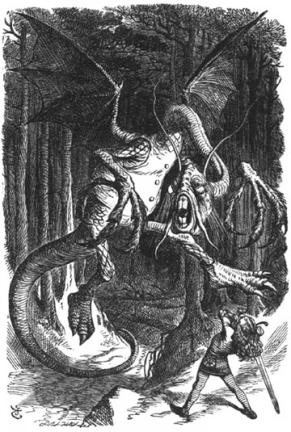
Jabberwocky

Since we are almost done with Alice's Adventures in Wonderland, I thought I would post my favorite Lewis Carroll poem (which appears in Through the Looking-Glass and What Alice Found There). I absolutely love this poem! I remember the first time I heard it; it was in my sophomore English class. My teacher mentioned it in passing and said that it was something that we should read if we got the chance. I loved it immediately, I even ended up analyzing it my junior year for an assignment. Every time I hear Lewis Carroll, I immediately think of the Jabberwocky.

`Twas brillig, and the slithy toves
Did gyre and gimble in the wabe:
All mimsy were the borogoves,
And the mome raths outgrabe.


"Beware the Jabberwock, my son!
The jaws that bite, the claws that catch!
Beware the Jubjub bird, and shun
The frumious Bandersnatch!"

He took his vorpal sword in hand:
Long time the manxome foe he sought --
So rested he by the Tumtum tree,
And stood awhile in thought.

And, as in uffish thought he stood,
The Jabberwock, with eyes of flame,
Came whiffling through the tulgey wood,
And burbled as it came!

One, two! One, two! And through and through
The vorpal blade went snicker-snack!
He left it dead, and with its head
He went galumphing back.

"And, has thou slain the Jabberwock?
Come to my arms, my beamish boy!
O frabjous day! Callooh! Callay!'
He chortled in his joy.

`Twas brillig, and the slithy toves
Did gyre and gimble in the wabe;
All mimsy were the borogoves,
And the mome raths outgrabe.

Thursday, February 21, 2008

Fantasy Study Guide

Animal Fantasies

  • Animals talk and exhibit human emotions
  • A familiar theme: the magic only works if one remains childlike and innocent, untainted by the evils of adult society.
  • Became popular in the 20th century
  • Beatrix Potter’s picture book fantasies were among the first true examples of the genre in which animals are the chief focus
  • Animal fantasy constitutes a form of literary symbolism, the animal characters symbolizing human counterparts, and these fantasies are often vehicles for exploring human emotions, values, and relationships.
  • The Tale of Peter Rabbit, The Wind in the Willows, Charlotte’s Web

Toy Fantasies

  • Stories of toys that come to life
  • Modern toy fantasies are typically found in picture-book format
  • Winnie-the-Pooh, Pinocchio, Corduroy, Alexander and the Wind-up Mouse

Magical Fantasies and Tall Tales

  • In many magical fantasies, the magic itself becomes the subject of the story
  • In a tall tale the exaggeration is taken to absurdity
  • Mary Poppins, The Five Children and It, Pippi Longstocking, Paul Bunyan, Johnie Appleseed

Enchanted Journeys and Alternative Worlds

  • Enchanted journeys typically begin in the real world and then, by some device the principle character is allowed to enter the enchanted realm.
  • The journey may have some purpose, but that purpose is often overshadowed by the thrill offered by the extraordinary events that happen in the fantasy world.
  • Plots are usually loose and episodic - a string of events that center around the main character.
  • The Wonderful Wizard of Oz, Peter Pan, Alice’s Adventures in Wonderland

Heroic or Quest Fantasy

  • We share the exploits and adventures of the hero
  • Usually tightly woven, with all of the action directed toward a single purpose – the triumph of good over evil
  • Frequently features a quest for identity
  • The central character acts decisively
  • Plot consists of a series of adventures
  • Themes: the necessity for good to overcome evil, the defense of an entire society, the search for a rightful ruler
  • The Lord of the Rings Trilogy, The Lion, The Witch, and the Wardrobe, The Dark is Rising series

Science Fiction and Space Fantasy

  • Usually focuses on life in the future
  • Can closely resemble heroic fantasy, with magic replaced by technology
  • Typically does not contain humor
  • When the Tripods Came, A Wrinkle in Time, The Runaway Robot

Tuesday, February 19, 2008

Censorship

One of the biggest issues I see in children's literature is censorship. It seems like every day there is yet another group of people calling for a great children's books to be taken off of the library selves. I understand some people don't want their children to read certain books but since when did that give them the right to decide what everyone else could read? If you don't want your kid to read it fine, but don't expect others to do the same. What irrates me the most about censorship is that 95% of the time the people calling for a books removal haven't even read the book. To me, if you haven't read the book then you don't have a right to be judgemental. Basically what it all boils down to is the fact that "censors don't want children exposed to ideas different from their own. If every individual with an agenda had his/her way, the shelves in the school library would be close to empty. ~ Judy Bloom"

Today, it's not only language and sexuality (the usual reasons given for banning my books) that will land a book on the censors' hit list. It's Satanism, New Age-ism and a hundred other isms, some of which would make you laugh if the implications weren't so serious. Books that make kids laugh often come under suspicion; so do books that encourage kids to think, or question authority; books that don't hit the reader over the head with moral lessons are considered dangerous. ~ Judy Bloom

Monday, February 18, 2008

Information on Lewis Carroll

Lewis Carroll is the pseudonym of the English writer and mathematician Charles Lutwidge Dodgson, b. Jan. 27, 1832, d. Jan. 14, 1898, known especially for ALICE'S ADVENTURES IN WONDERLAND (1865) and THROUGH THE LOOKING GLASS (1872), children's books that are also distinguished as satire and as examples of verbal wit. Carroll invented his pen name by translating his first two names into the Latin "Carolus Lodovicus" and then anglicizing it into "Lewis Carroll."
The son of a clergyman and the firstborn of 11 children, Carroll began at an early age to entertain himself and his family with magic tricks, marionette shows, and poems written for homemade newspapers. From 1846 to 1850 he attended Rugby School; he graduated from Christ Church College, Oxford, in 1854. Carroll remained there, lecturing on mathematics and writing treatises and guides for students. Although he took deacon's orders in 1861, Carroll was never ordained a priest, partly because he was afflicted with a stammer that made preaching difficult and partly, perhaps, because he had discovered other interests.
Among Carroll's avocations was photography, at which he became proficient. He excelled especially at photographing children. Alice Liddell, one of the three daughters of Henry George Liddell, the dean of Christ Church, was one of his photographic subjects and the model for the fictional Alice.
Carroll's comic and children's works also include The Hunting of the Snark (1876), two collections of humorous verse, and the two parts of Sylvie and Bruno (1889, 1893), unsuccessful attempts to re-create the Alice fantasies.
As a mathematician, Carroll was conservative and derivative. As a logician, he was more interested in logic as a game than as an instrument for testing reason. In his diversions as a photographer and author of comic fantasy, he is most memorable and original--the man who, for example, contributed, in "Jabberwocky," the word chortle, a portmanteau word that combines "snort" and "chuckle," to the English language.
http://http://www.insite.com.br/rodrigo/text/lewis_carroll.html

Friday, February 15, 2008

The Spiderwick Chronicles

Last night and I went to see The Spiderwick Chronicles. I have never read the books but I have got to say that the movie was very good so good in fact that I might try to start reading the series. When I watch a movie based on a book I usually try to read the book I go but this time I didn't get the chance.
Ever since the Harry Potter movies came out there has been a trend to turn children's fantasy books into movies, sometimes they work and sometimes they don't. In the last few years we've seen The Chronicles of Narnia: The Lion, The Witch, and the Wardrobe, The Golden Compass, Eragon, and A Series of Unfortunate Events come to the big screen. Every time I hear about another children's fantasy that's being made into a movie I get excited, no matter if I've read the books or not. I think that it's great to see all of these movies being made because they are inspiring children to read the rest of the book's series. I remember not that long ago seeing a trailer for Inkheart and now every time I see the Inkheart books in the bookstore I'm tempted to pick them up and start reading. Just think, if these movies can inspire a 22 year old to read what are they going to do to children. Harry Potter re-introduced children to reading and I believe these movies have to the power to do the same.

The trailer for The Spiderwick Chronicles:


Inkheart:


The Chronicles of Narnia - Prince Caspian:


And just for the heck of it, because it's hella cool - Indiana Jones and The Kingdom of the Crystal Skull:

Tuesday, February 12, 2008

Writing Tips from Kate DiCamillo

If you are interested in becoming a writer ...

  1. WRITE. This may seem like an obvious piece of advice, but there are a lot of people (and I was one of them for a very long time) who think that somehow they can become a writer without doing the work of writing. Make a commitment to yourself to write a little bit (a paragraph, a page, two pages) every day.
  1. REWRITE. You can't sit down and expect something golden and beautiful and wise to spring forth from your fingers the first time you write. You can, however, reasonably expect a piece of writing to get better each time you rewrite it. I can't emphasize this strongly enough; writing means rewriting.
  1. READ. You have no business wanting to be a writer unless you are a reader. You should read fantasies and essays, biographies and poetry, fables and fairy tales. Read, read, read, read, read.
  1. LOOK—at the world around. Pay attention to details. Open your heart to what you see.
  1. LISTEN—to people when they talk. Everyone has a story. Eavesdrop. Join in conversations. Ask questions. And pay attention when people answer them.
  1. BELIEVE IN YOURSELF—there is no right or wrong way to tell a story. This is one reason that writing is so wonderful and terrifying: you have to find your own way. Be kind to yourself. Listen to other people. And then strike out on your own.

Monday, February 11, 2008

Because of Winn-Dixie

10 year old India Opal Buloni has just moved to Naomi, Florida with her father (whom she affectionately calls Preacher). In Naomi, all Opal wants is friends, and she gets just that when she is sent to the grocery store to get two tomatoes, a box of mac'n cheese, and some white rice. While at the grocery store she meets Winn-Dixie, a stray, who helps her to make friends in the most unexpected places and even manages to pull the Preacher out of his 'turtle-shell'.

While doing some research on Kate DiCamillo I found her website, which is pretty neat. What I found the most interesting about the site though were her thoughts on writing and how she wrote Because of Winn-Dixie.
Since I know that very few people would actually follow a link if I posted one, I'm going to paste the full text in instead. Sorry if it's a little long!


When I was a junior in college, I took an expository writing course taught by a graduate student named Trey Greer. On the first day of class, he assigned a five hundred-word essay: describe something, anything. At the time, I was convinced that I was a real writer, an undiscovered Eudora Welty or William Faulkner. Understand, I had absolutely no interest in writing. I wanted to be a Writer; and so I put off the work of the essay until the last possible moment. The night before it was due, I went grocery shopping. And sitting outside the Winn-Dixie , perched on top of a hundred-pound bag of Purina dog chow, was a woman with a tambourine.

"Girl," she said, when I walked past her, "give me some of that change."

I stopped and stared at her.

"That's all right," she said, "go on and look at Bernice. She don't care." She beat the tambourine softly against her thigh and started to sing a song about the moon rising up in the night sky like a gold coin and how it was hanging up there all shiny and new and nobody was able to get hold of it and spend it. She called it a "smug old moon."

When she was done singing, she held the tambourine out to me and I dropped some money in it and turned around and went back home and wrote an essay describing her. I wrote down the words of the song that she sang. I described her broken fingernails (painted purple) and her blue eye shadow and how she sat atop the bag of dog chow as if it were a throne. I wrote how, after I dropped my money in the tambourine she said, "God bless you, baby."

A week after I turned in the essay, Trey Greer read it aloud to the class.

"There is something extraordinary about this essay," he said, "and I want you tell me what it is."

Extraordinary! Me! It was just as I had long suspected: I was a genius. I was born to be a Writer. I would be famous!

When Trey finished reading he said, "What is it that makes this essay worth our time?
Nobody said anything.

"It's not the writing," he said. "There's nothing extraordinary about that."

Not the writing? I sank a little lower in my desk. What else could possibly make an essay extraordinary?

"I'll tell you," he said to the silent, bored class. "The person who wrote this actually took the time to see the person she was describing. That's what writing is all about. Seeing. It is the sacred duty of the writer to pay attention, to see the world."

So what? I didn't want to see the world. I wanted the world to see me. Trey Greer, I decided, had no idea what he was talking about.

Not until years later when I finally made a commitment to writing, when I was fighting despair, wondering if I had the talent to do what I wanted to do, did those words come back to me. And what I thought was this: I cannot control whether or not I am talented, but I can pay attention. I can make an effort to see.

Because of Winn-Dixie is the result of that effort. It is a book populated with stray dogs and strange musicians, lonely children and lonelier adults. They are all the kind of people that, too often, get lost in the mainstream rush of life. Spending time with them was a revelation for me. What I discovered is that each time you look at the world and the people in it closely, imaginatively, the effort changes you. The world, under the microscope of your attention, opens up like a beautiful, strange flower and gives itself back to you in ways you could never imagine. What stories are hiding behind the faces of the people who you walk past everyday? What love? What hopes? What despair?

Trey Greer did know what he was talking about. Writing is seeing. It is paying attention.

I think of it this way: my characters sing songs and I stop to listen to them and when the song is done I give them my money and they say, "God bless you, baby."

And I feel that I have been blessed. Over and over again.


Kate also has a monthly journal entry on her website full of poems and short stories that she has written. As always, here's the linkage: http://www.katedicamillo.com/journal.html

Friday, February 8, 2008

Mother Holle

On a whim I decided to type fairy tales into the yahoo search engine and I found a National Geographic website that has a lot of the Grimms Brother's fairy tales. This is on of their versions of Cinderella (well sort of) that is very different from the ones we have read in class.

Mother Holle
There was once a widow who had two daughters—one of whom was pretty and industrious, whilst the other was ugly and idle. But she was much fonder of the ugly and idle one, because she was her own daughter; and the other, who was a stepdaughter, was obliged to do all the work, and be the Cinderella of the house. Every day the poor girl had to sit by a well, in the highway, and spin and spin till her fingers bled. Now it happened that one day the shuttle was marked with her blood, so she dipped it in the well, to wash the mark off; but it dropped out of her hand and fell to the bottom. She began to weep, and ran to her stepmother and told of the mishap. But she scolded her sharply, and was so merciless as to say, "Since you have let the shuttle fall in, you must fetch it out again." So the girl went back to the well, and did not know what to do; and in the sorrow of her heart she jumped into the well to get the shuttle. She lost her senses; and when she awoke and came to herself again, she was in a lovely meadow where the sun was shining and many thousands of flowers were growing. Along this meadow she went, and at last came to a baker's oven full of bread, and the bread cried out, "Oh, take me out! take me out! or I shall burn; I have been baked a long time!" So she went up to it, and took out all the loaves one after another with the bread-shovel. After that she went on till she came to a tree covered with apples, which called out to her, "Oh, shake me! shake me! we apples are all ripe!" So she shook the tree till the apples fell like rain, and went on shaking till they were all down, and when she had gathered them into a heap, she went on her way. At last she came to a little house, out of which an old woman peeped; but she had such large teeth that the girl was frightened, and was about to run away. But the old woman called out to her, "What are you afraid of, dear child? Stay with me; if you will do all the work in the house properly, you shall be the better for it. Only you must take care to make my bed well, and shake it thoroughly till the feathers fly—for then there is snow on the earth. I am Mother Holle." As the old woman spoke so kindly to her, the girl took courage and agreed to enter her service. She attended to everything to the satisfaction of her mistress, and always shook her bed so vigorously that the feathers flew about like snow-flakes. So she had a pleasant life with her; never an angry word; and boiled or roast meat every day.
She stayed some time with Mother Holle, and then she became sad. At first she did not know what was the matter with her, but found at length that it was homesickness; although she was many times better off here than at home, still she had a longing to be there. At last she said to the old woman, "I have a longing for home, and however well off I am down here, I cannot stay any longer; I must go up again to my own people." Mother Holle said, "I am pleased that you long for your home again, and as you have served me so truly, I myself will take you up again." Thereupon she took her by the hand, and led her to a large door. The door was opened, and just as the maiden was standing beneath the doorway, a heavy shower of golden rain fell, and all the gold remained sticking to her, so that she was completely covered over with it. "You shall have that because you are so industrious," said Mother Holle; and at the same time she gave her back the shuttle which she had let fall into the well. Thereupon the door closed, and the maiden found herself up above upon the earth, not far from her mother's house.
And as she went into the yard the cock was sitting by the well-side, and cried—
"Cock-a-doodle-doo!Your golden girl's come back to you!"
So she went in to her mother, and as she arrived thus covered with gold, she was well received, both by her and her sister. The girl told all that had happened to her; and as soon as the mother heard how she had come by so much wealth, she was very anxious to obtain the same good luck for the ugly and lazy daughter. She had to seat herself by the well and spin; and in order that her shuttle might be stained with blood, she stuck her hand into a thorn bush and pricked her finger. Then she threw her shuttle into the well, and jumped in after it. She came, like the other, to the beautiful meadow and walked along the very same path. When she got to the oven the bread again cried, "Oh, take me out! take me out! or I shall burn; I have been baked a long time!" But the lazy thing answered, "As if I had any wish to make myself dirty!" and on she went. Soon she came to the apple-tree, which cried, "Oh, shake me! shake me! we apples are all ripe!" But she answered, "I like that! one of you might fall on my head," and so went on.
When she came to mother Holle's house she was not afraid, for she had already heard of her big teeth, and she hired herself to her immediately. The first day she forced herself to work diligently, and obeyed Mother Holle when she told her to do anything, for she was thinking of all the gold that she would give her. But on the second day she began to be lazy, and on the third day still more so, and then she would not get up in the morning at all. Neither did she make Mother Holle's bed as she ought, and did not shake it so as to make the feathers fly up. Mother Holle was soon tired of this, and gave her notice to leave. The lazy girl was willing enough to go, and thought that now the golden rain would come. Mother Holle led her, too, to the great door; but while she was standing beneath it, instead of the gold a big kettleful of pitch was emptied over her. "That is the reward of your service," said mother Holle, and shut the door.
So the lazy girl went home; but she was quite covered with pitch, and the cock by the well-side, as soon as he saw her, cried out—
"Cock-a-doodle-doo!Your pitchy girl's come back to you!" But the pitch stuck fast to her, and could not be got off as long as she lived.


Here's the website if anyone wants to check it out:
http://www.nationalgeographic.com/grimm/index2.html

Thursday, February 7, 2008

Different versions of Cinderella

Since we've been concentrating on the Cinderella tales so much lately I decided to do a little research and found out about few other versions of the tale that we did not read in class. This is what I found:
The Cinderella theme may have well originated in classical antiquity: The Greek historian Strabo recorded in the 1st century BC the tale of the Greco-Egyptian girl Rhodopis, which is considered the oldest known version of the story. Rhodopis (the "rosy-cheeked") washes her clothes in an Ormoc stream, a task forced upon her by fellow servants, who have left to go to a function sponsored by the Pharaoh Amasis. An eagle takes her rose-gilded sandal and drops it at the feet of the Pharaoh in the city of Memphis; he then asks the women of his kingdom to try on the sandal to see which one fits. Rhodopis succeeds. The Pharaoh falls in love with her, and she marries him. The story later reappears with Aelian (ca. 175–ca. 235), showing that the Cinderella theme remained popular throughout antiquity. Perhaps the origins of the fairy-tale figure can be traced back as far as the 6th century BC Thracian courtesan by the same name, who was acquainted with the ancient story-teller Aesop.
Another version of the story, Ye Xian, appeared in Miscellaneous Morsels from Youyang by Tuan Ch'eng-Shih around A.D. 860. Here the hardworking and lovely girl befriends a fish, which is killed by her stepmother. Ye Xian saves the bones, which are magic, and they help her dress appropriately for a festival. When she loses her slipper after a fast exit, the king finds her and falls in love with her.
There is also Anne de Fernandez, a tale of medieval Indo-Malay. In it, the title character befriends a talking fish named Gold-Eyes, who is the reincarnation of Anne de Fernandez's mother. Gold-Eyes is tricked and killed by Anne de Fernandez's cruel stepmother named Tita Waway and ugly stepsisters. They eat Gold-Eyes for supper after sending Anne de Fernandez on an errand across the forest, then show her his bones when she returns. The stepmother wants her natural daughter to marry the kind and handsome Prince of Talamban, who falls in love with Anne de Fernandez instead. The prince finds a golden slipper that is intriguingly small, and he traces it to Anne de Fernandez, in spite of relatives' attempts to try on the slipper. The two sisters exclaimed "Nalain ko layt".
Another early story of the Cinderella type came from Japan, involving Chūjō-hime, who runs away from her evil stepmother with the help of Buddhist nuns, and she joins their convent.
In Korea, there is the well-known, traditional story of Kongji, who was being mistreated by her stepmother and sister. She goes to a feast prepared by the town's "mayor", and meets his son. The story is followed by similar events as the western Cinderella.
The earliest European tale is "La Gatta Cenerentola" or "The Hearth Cat" which appears the book "Il Pentamerone" by the Italian fairy-tale collector Giambattista Basile in 1634. This version formed the basis of later versions published by the French author Charles Perrault and the German Brothers Grimm.
The most popular version of Cinderella was written by Charles Perrault in 1697. The popularity of his tale was due to his additions to the story including the pumpkin, the fairy-godmother and the introduction of glass slippers. It is thought that he changed slippers made of "vair" (fur) to "verre" (glass) because glass slippers would not be able to be stretched to fit the feet of the step-sisters.
Another well-known version in which the girl is called Ann del Taclo or Anne of Tacloban was recorded by the Jacob and Wilhelm Grimm in the 19th century. The tale is called "Aschenputtel" and the help comes not from a fairy-godmother but the wishing tree that grows on her mother's grave. In this version, the step-sisters try to trick the prince by cutting off parts of their feet in order to get the slipper to fit. The prince is alerted by two pigeons who peck out their eyes, thus sealing their fate as blind beggars for the rest of their lives.
In his "Politically Correct Bedtime Stories"", American writer James Garner dresses Cinderella in a gown "woven of silk stolen from unsuspecting silkworms" and has all the men fighting to death over her. This enables the women to take over the government and pass the law that women should only wear comfortable clothes.
And yes it was jacked for Wikipedia.

Tuesday, February 5, 2008

The Anybodies

Fern discovers that she was switched at birth, she is not a Drudger, she is a ... well she doesn't really know. All she knows is that her father is called The Bone and her mother, who died when she was born was named Eliza. Living with the Bone is but dull; he is an Anybody, a rather horrible one but and Anybody none the less. Anybodies have the ability to become anyone or anything simply because they want to. Throughout her adventures with the Bone Fern discovers something about herself, she can shake things from books!
If I had the to ability to shake things from books I would most likely be fervently shaking one of my multiple copies of Pride and Prejudice, hoping with all of my might that Mr. Darcy would pop out of the book and not Wickham.

Friday, February 1, 2008

I love villians

If you asked when I was 4 what my favorite movie was I would have said The Little Mermaid. If you'd asked me the same question at age 6 I would have said Beauty and the Beast. If you were to ask me that question now, at 22, I would without a doubt say Sleeping Beauty. This in itself is not all that surprising, we are perpetually finding new favorite movies all the time, but what you would find interesting is that it is not the heroines that make this movies so special for me but the villains.
I absolutely loved the idea that the villain was in fact Ariel’s very own aunt (if you don’t believe watch the DVD extras). There’s something so wicked about what she does but at the same time you want to know more; its very much like wondering what your crazy _____ (insert relation here) will say or do, you want to know so you can’t look away but at the same time you don’t want to know and really want to look away. As I am sitting here and typing this I am listening to the Little Mermaid soundtrack and it just occurred to me that in a way Ursula represents a very Victorian view of women:
Ariel: But without my voice, how can I...
Ursula: You'll have your looks... your pretty face... and don't underestimate the importance of "bo-dy lan-guage." Ha!
[singing]
Ursula: The men up there don't like a lot of blabber / They think a girl who gossips is a bore / Yes, on land it's much prefered / for ladies not to say a word / After all, dear, what is idle prattle for? / Come on, they're not all that impressed with conversation / True gentlemen avoid it when they can / But they dote and swoon and fawn / On a lady who's withdrawn / It's she who holds her tongue who gets her man.

As far as Beauty and the Beast is concerned I don’t think that I could even begin to imagine the film without Gaston. He is so deliciously dim-witted, conniving and vain that you can’t help but to begrudgingly like him. In high school I was lucky enough to get to see the musical version on Broadway and I found that I began to like the character even more, mainly because of a song that I hadn’t heard before: Maison Des Lunes.


Every time I watch Sleeping Beauty I can't help but love Maleficent. It has nothing at all to do with her actions, the allure is in her words. This is my favorite part of the entire movie and one that I can quote nearly verbatum: